I run my finger along the marker at the edge of our farm. Its wood is parched from time and weather. A locomotive’s soprano voice carries across the prairie. I picture that engine puffing into a station where the platform swirls with a symphony of tongues. I think of families boarding with slumped shoulders and weary eyes. I recall how we, my parents, my brothers and I, stepped onto the colonist car with its sunlit windows and faintly sweet fragrance. Around us, men snored while mothers cooed at young ones latched to their breast. I witnessed my older brother, Wasyl, rub his teary eyes as the train pulled us westward.
We had boarded that car at the docks. This came after countless days of retching and moaning deep inside the steamship. I swaddled my baby sister, Ana, inside my sheepskin coat. We clung to each other while the Atlantic’s undulations tossed our ship. The worst part about feeling her body shiver from the cold was when it stopped. As Papa caressed her pale cheek, the sash fell from her linen.
One-by-one, families lost their weaker members. Lifeless bodies were tossed over to the tumultuous brine where sharks circled. In our dark quarters, Ana’s sash felt soft in my palm. I curled my knees to my ribs and leaned into our cabin’s dank rot.
The ship’s baritone honk was the first sound I remember after the ocean’s heaves subsided. Halifax harbour opened its arms as the S.S. Scotia let out one final sigh, pushing its contents into the New World. Arms, legs, and torsos pressed through the corrals. Flies mingled in manure. My younger brother, Philip, pointed a finger at screeching seagulls by a barrel of smoked cod. Steam and soot emanated from everywhere, even bovine snouts. Our vessel had no sooner exhaled the last emigrating family before its crew stuffed lumber, grains, and livestock into the holds. A balking horse broke free of its rope, delivering a snap that resonated through my navel.
I remember the mechanical chatter, clatter, and clicks of our railroad journey. Station by station, rolling hills smoothed out to a flat expanse. After Winnipeg, we unfolded the benches and stretched our legs. Mama loosened my braids and stroked my hair. Papa laid out bread and cheese from our sacks while my brothers wrestled in the aisle. Our heartbeats drummed with the swish-swish on the track.
The steam engine’s bell heralded our arrival in Moose Jaw. I recall stepping out to fresh warm air. Philip held Mama’s hand while Papa and Wasyl packed the wagon with bushels, barrels, and wood. The train’s aria echoed in the distance as we trekked out of town. Papa led the horses while we ambled alongside the wagon.
When we stopped, the swaying tall grass tickled at my skirt. Papa’s spade rang out as he struck a timber marker into the ground. I secured Ana’s sash around it and looked up to the wide sky. We, all of us, were home.
Previously published.
Original publication credit:
“Eighteen Ninety-Seven.” CommuterLit: Fiction on the Go, June 15, 2021, http://commuterlit.com/2021/06/tuesday-eighteen-ninety-seven/.
Reprint:
“Eighteen Ninety-Seven.” Blank Spaces: Filling the Gap with Story & Colour, vol. 6, is.2, December 2021, pp. 23-24.
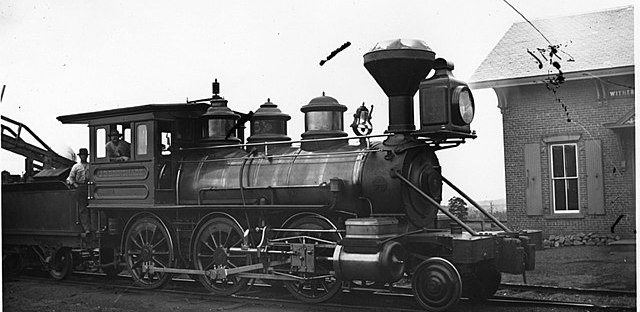
Image: J. B. Brinsmade locomotive at station, about 1900 pulling into a station in Canada. Image in black and white of an ancient steam train with the driver leaning out of the cab and a station building in the background. From Wikimedia Commons

 literally stories
Pauline
The Atlantic is full of the ghosts of the poor and enslaved as it is with sailors and crews. Naturally, even a few rich people are down there as well, the Davy Jones’ one-percenters.
Understated and extremely effective. Also a tribute to the hardy souls whose blood still runs today.
Leila
LikeLike
Richly descriptive and timely!
LikeLiked by 1 person
Personal histories are legion, ‘ordinary’ people doing extraordinary things and so family legends are written. This has a warm and gentle tone, perfect for the subject. An enjoyable read. Thank you – dd
LikeLiked by 2 people
Fine writing, Ana’s sash was a lovely parting touch.
My gran had four brothers and sisters; four times she stood on Liverpool docks to wave them goodbye. Hard times.
LikeLiked by 1 person
Pauline
I lost the relief and the heartbreaking rewards of tears several years ago, but they were gathering inside for another try when I got to the end of “Eighteen Ninety-Seven.” All four of my grandparents made that trip in the 1890’s to NYC. No one ever spoke of it. Thanks for stirring up some of what it must have felt like. — Gerry
LikeLike
I’ve never known anything about my ancestors’ immigration. This story, with poignancy and realism, helps me imagine how it might have been.
LikeLiked by 1 person
Hi Pauline,
This might sound stupid but I never knew that London was re-called anywhere. I thought those arrogant bastards would never have allowed that!!!
There was no dialogue in this and for me that worked very well.
Hope you have more for us very soon.
Hugh
LikeLike
Fun bit of history: This London was intended to be the capital of Upper Canada in the late 18th century. It was won-out, however, by what’s now called Toronto (Ontario’s provincial capital today).
We also have a Thames river and share many of the same street names as “The London.”
Thanks for your comment, Hugh! Take care.
LikeLiked by 2 people
Little did they know, their hard work had only just begun. The sea voyage was indeed rough, I’ve heard the stories passed down. There was quarantine also if there had been a TB outbreak on the ship, esp. for immigrants from Ireland. Many people left Europe due to persecution of one kind or another, to find a world of their own.
LikeLiked by 1 person
A rich and poignant piece with some really wonderful descriptions and sense of purpose.
LikeLike
Thank you, everyone, for your kind words.
And Literally Stories, great choice on the featured image. I love it!
LikeLiked by 1 person
Evocative. Sounds like it may be part of a novel?
LikeLike