
He stood in the doorway of her sewing room, saying nothing, rocking back and forth on the threshold. She had been expecting him, but it was the alternating squeak and swish of his rocking that caught her attention, “What time do you have to be there?”
She had asked without looking up at him, keeping her head down, continuing to focus on the Latin homework she needed to correct and return to her students on Monday. The question, directed downward like it was, had no choice but to bounce off her desktop and ricochet around the room until it finally landed on the boy who resembled her husband in so many ways. He didn’t answer, and she left her correcting chores, looked at him, and asked again. The repeated question was hardened this time by the irritation she felt for having to turn away from her work.
Growing up, work had been the centerpiece of her life on the farm. Moments of reflection were devoted to how could the work have been done better. Moments of conversation were used to plan the work for the day or the week or the season. Extracting the most work possible from the time the Lord allowed was the ethic laid down before her, and when that was achieved one was allowed a moment of quiet satisfaction. Quiet, of course, because to voice it would have been prideful, and pride, after all, was the greatest sin.
It was an ethic that had served her well in high school. She’d graduated first in her class. A moment of quiet satisfaction all around at this achievement, and then she went on to college. Not because she was bright and a valedictorian and had a gift for math and languages, but because she was a girl and her father had no need of her. He liked her well enough, she knew, but she wasn’t the boy he had wanted, the one who could run the farm, the one who would keep the farm in the family, the one who would keep the place where a man could grow old and die surrounded by familiar things. She could not do that for him, and her mother could have no more children for him, and that was that. One woman was enough for a farm. It was all understood and it wasn’t personal, so it wasn’t necessary to speak of it.
At some late dawning moment in her life, she had realized that in going to college she had been living her mother’s dream. The woman who had taught her to cook and wash and mend and sew had also taught her to read and filled her home with books, but in those moments when she allowed herself the luxury to think about the past, it was the card games she associated with her mother.
When farming was in full swing, the men had to take two hours off at midday because the horses needed to rest. Her mother would have the meal on the table at noon. It would be consumed quickly—virtually in silence— then her father and the hired men would return to the barn to play cards until the horses were ready to go back to work. She and her mother would clear the table, and then her mother would march out to the barn and join in the game. She knew that her mother was the best of them all at their foolish little game called Pitch. She could tell by the way the men held themselves around her, the tilt of their heads and hands and torsos, acknowledging that her mother was the smartest card player among them.
Inheriting that gift of cards from her mother, she had taught her family to play Pitch and Whist and Bridge. Her husband was hopeless. Her younger son showed promise, but the older boy, the one who stood rocking on the threshold before her… She stopped as her thoughts discovered her and wondered what promise her young man-child held.
“Seven-thirty.” the boy answered. “But we don’t have to leave to get there early. Only the girls and the geeks get there early.”
“Will your father take you?”
“He’s watching game films. I don’t have to go, you know.”
“It’s an honor to be selected for regional choir. Something to put on a college application that doesn’t end in the word ball, so you’re going to go. I’ll take you.”
“I sing for crap. Better kids than me didn’t get selected.”
“And why is that?’
“Because the choir director didn’t think they could afford the white shirt and black pants and shoes. Not sneakers, that’s why.”
“Since when have you been so tuned in to social injustice?”
“Ask Dad if I’m right. Poor kids play football. I don’t think they take much Latin.”
“We’ll leave at seven-ten, promptly.”
“That’s way early.”
“Seven-ten,” she said to his back.
Ironic. Her mother couldn’t have boys and she had only boys. What had she been so desperate for that would cause her to marry the first boy who ever said thank you to her? That first day of college, she had watched him carrying too many books across the campus’s hilly terrain. “Ten pounds of nuts in a five-pound bag,” her father would have said, dismissing him as a man who could not plan his work. Dismissive was a good place to start in describing the relationship between her father and her husband. She had helped the gangly boy pick up the books he inevitably dropped and carried half of them to his dorm for him.
“Thank you,” he had said. “Thank you very much.” The words came naturally enough from him, and all those out-loud words of thanks had surprised her. Was it not expected that she would pitch in and help, and, as her thanks, receive a silent nod, acknowledgement that she had met expectations?
A week later they agreed to meet for coffee and had been together ever since. He was the third son in a five-son, farm family, knew all about hard work and believed in it, but he told her right away that he wouldn’t be getting the family farm. His father had encouraged his sons to compete for his favor with the farm as the prize, and he, the biggest, roughest son of them all, had tired of it. He detested the conflict and had escaped on a football scholarship. He wanted to teach high school history and coach. They were perfect for each other. She felt relieved.
The day she introduced him to her father she was reminded of two cats that didn’t like each other much, but didn’t want to fight. She had brought home a farmer’s son who didn’t want to farm, a man who just wanted to teach, not be a principal someday, a man who would like to make part of his living by teaching boys to play a game. On the way back to school he told her what a great visit he’d had. She met his father later that year and decided their respective fathers were much alike.
Teach or nurse. Those had been her choices, the only appropriate outside work for a woman, and she didn’t want to be a nurse. She was sure she didn’t like people well enough for that. Sometimes in the paper she read about a doctor or a lawyer or an architect with a woman’s name, but she was persuaded they were all Jewish names. She had envied them—her Jewish classmates—or rather envied their dreams. If she had been reading Irish names, like hers, then she would have worried she had missed some cue, some silent signal that would have told her that her tribe expected something more from her, worried that she had failed.
Irish names and Irish hands she thought. She spread her hands out on her desk. Her husband hadn’t seen the jeweler’s look when he’d sized her finger on the day they got the ring. The little shop hadn’t had a woman’s ring big enough for her to try on, and she’d been embarrassed once again by those big hands. They were so out of proportion to the rest of her. She had even entertained the momentary nightmare that he would call the wedding off because of them. “Your hands are too big you know,” he’d say to her with regret, but what she saw was a man too delirious in love with her to even notice her hands, and she loved him all the more for that.
They had grown into a good team, like her father’s favorite horses, “Bill and Peg – what a team they are,” he’d say. “You never have to speak to them. They can work a field in complete silence.” She wondered if that was the measure of merit in a marriage, being able to work a field in complete silence. No gentle nudge. No need to touch. If so, they were almost there.
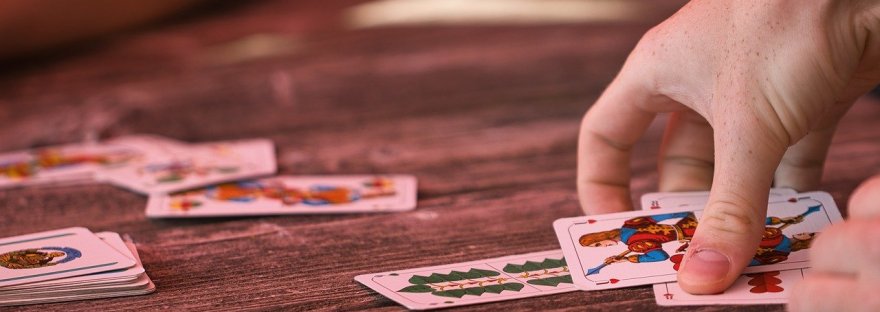
Image by Alexander Fox | PlaNet Fox from Pixabay – playing cards on a rough wooden surface.

 literally stories
John
What strikes most is the thread of family being present through the generations even though youth is seldom aware of it. The MC is keenly aware of this and it shines through the restrained, concise prose.
Leila
LikeLike
Straightforward – that’s the word that came to mind and that, I think, is the strength of this piece. As a way to live it is honorable and ‘real’ and if, now and then, there are niggles that maybe there should have been more they can be swept aside by the honesty of it all – I enjoyed reading this. Thank you – dd
LikeLiked by 2 people
What a wonderful evocative piece! And that ending!! It left me ruminating and I don’t know if you can ask more of a story.
LikeLike
This is lovely John – vivid and atmospheric, but still gentle. I really enjoyed it.
LikeLike
Yes John. It’s very beautiful because the language is direct and the things that happen are true and that’s very hard for a writer to do. Thanks so much. — Gerry
LikeLike
Fine writing, including a wonderful final paragraph. Thank you.
LikeLike
An evocative and bittersweet story about a life defined by hard work, family expectations, and silent sacrifices. I especially like how the story intertwines present moments with reflective memories to provide a detailed portrait of the woman.
LikeLiked by 2 people
Hi John,
I see you used the word ‘ironic’ and within your story you said, ‘Poor kids play football. I don’t think they take much Latin’. I love to think that if they become successful at a sport that is the epitome of irony!!
This was really thought provoking and we will all have our own thoughts on family life that YOU have instigated.
‘Living a parents dream’ is something that should never happen but does far too many times.
Perceptive and very clever!!!!
All the best.
Hugh
LikeLike
As others have said there is a gentleness and wistfulness to this that charm the reader with this steady and masterful prose.
LikeLiked by 1 person
A story of the generations…. we’ve moved from a mostly rural to an urban society and this story tells about that, and about the changing roles of women and men and the changing idea of family. I like the story of this particular woman and her life, and underneath her love story.
LikeLike