
She gave me the grandest name. Bardonneche. Lovely isn’t it. Didn’t suit me at all. Or not so’s you could see. Would suit me even less now, pruned up bag of bones that I am. But I wasn’t pretty even then. Mind you, neither was she. Pretty we were not.
She was Cleanthes, I was Bardonneche. We became a team.
It was I introduced her to the world of the kippensammler. There being the two of us, of course, would make us kippensammlerinnen. I showed her the ropes, as they say. Times were hard. The dimp, the dog-end, the stubbed-butt had value. It’s what we did. We gathered cigarette butts – using the bits of tobacco they contained to roll new cigarettes, which we could then sell or barter – for food, for candles, what have you.
Generally speaking, it took seven dimps to make one cigarette.
Cleanthes was not a quick learner. She’d been rolling her own since well before the War; it’s just that in all the time I knew her I never knew her to roll one truly successful cigarette. Some were rolled so tightly that no inhalation of smoke was possible, there being no ‘air’ in the cigarette; others were so loosely rolled they flared up and fell apart soon as lit. So it’ll not surprise you to learn that it was I did most of the rolling. Besides, even had Cleanthes rolled a perfectly fine cigarette, her refusal to fatten it with a few wood-shavings or a little sawdust made for plain bad economics. She was having none of it. It was cheating the poor, she said. We are the poor, I said. Everyone is the poor! Which was true enough. I mean, there were those who cooked rat to get by. Scurvy was the norm. A rumour of bread brought out the animal in folk. But no, to adulterate tobacco with impurities like sawdust was not on! Sooner chew glass than that. It’s how she was, everything up a notch, the smallest thing made to tower. It’s no wonder she got headaches.
We did what we could. As I say, we were a team. Cleanthes considered what we did a calling. ‘We are kippensammlerinnen’, she’d say.
I’ll say this: she was fearless when it came to collecting. Scarily so at times. She’d think nothing of raiding an ashtray left on a café table where, only minutes earlier, a group of soldiers had been sitting. She’d find half smoked stumps in the unlikeliest of places. Almost seemed like she’d tunnel for them, if need be. It was a service, she said. That’s what it was we provided: a service. It’s shoestring economics, I said. It’s survival. After all, in the world as it then was two cigarettes got you a Persian rug while five cigarettes got you an egg. With twenty cigarettes you had power, leverage, means. But for Cleanthes every cigarette was a consecrated object. Or near enough. But I wasn’t about to start blessing each one I rolled – though I had it’s true stopped adding crumbs of wood and what have you. She wouldn’t have it that we just traded in a commodity. In fact, ‘trade’ and ‘commodity’ were words that set her off. That’s when she’d talk like she hadn’t a clue. Socioeconomic this, psychopolitico that. Hold forth she would. She could steamroller – and it flattened all the more because delivered in a monotone that had to be heard to be believed. I’m not an educated person, I said. But on she’d go.
We stayed where we could. If a place had a roof, that was good enough. There were curfews, blackouts. The dread was soldiers, police, the Black Maria. Seemed to me Cleanthes didn’t dread them enough. What they do to people in those basements, I said . . . But I was never sure it registered, not fully, not properly. Her brow would crease, but then her brow would often crease. I looked for signs behind those little round specs of hers, but her eyes said as much as they ever did – by which I mean you could never quite tell whether or not what you’d said had registered.
Brown eyes. What a gaze.
What they saw in me I’ll never know. How you see is the person you are, she’d say. As though that explained something. Then she’d make things seem other than they were by naming them something else. The War was the coming of The Great Beast, or some such. There were other names for other things . . . Said she’d known a man who called cigarettes ‘christnumbers’. It’s how she was. Everything was something else.
I can’t remember when or why it was she took to calling me Bardonneche, but soon as she said the name I knew I was the better for it. Bar-donn-eche. What it means I’ve no idea. I’m not sure she ever told me. She probably did. But if so, I’ve forgotten. She was Cleanthes, I was Bardonneche. We were kippensammlerinnen, dimp-collectors. You could say we were kind of called to it.
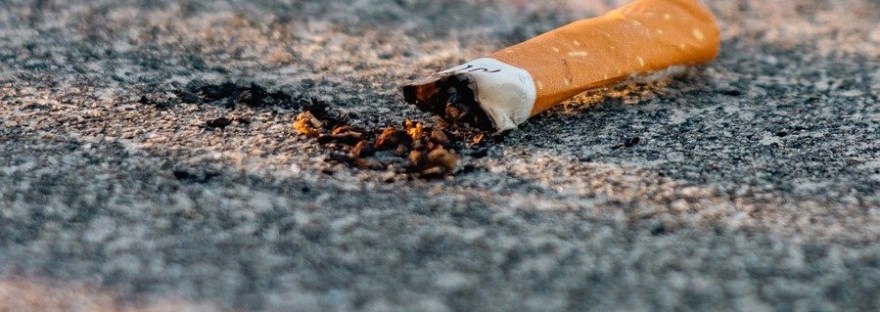
Image by Storme Kovacs from Pixabay A cigarette end crushed out on concrete.

 literally stories
Geraint
Love this one. Insolence toward poverty and a world in which old people may freeze to death because they cannot afford heat, but they better not be smokers. Lovely phrases, like everything to her was something else.
(I’ve been told the anti-smoking business is well funded. Poor people freezing to death, not so much.)
Leila
LikeLiked by 2 people
Absolutely, Leila. I’ve known a fair few homeless people freeze to death. And whenever those “rainy Tuesdays of the soul” descend (your fine phrase there) I sometimes simply recollect my own dimp-collecting days & the teeth-chattering nights that came with them – & the perspective shifts, or ought to!
LikeLiked by 1 person
This was a very satisfying and enjoyable read. Now and then everything comes together to make a thing that is greater than its parts. I think that happens with this piece. The tone, style, setting, emotion everything is just perfect and in a relatively small number of words a whole world is created with two visible characters at its centre. Super writing. Thank you – dd
LikeLiked by 1 person
Appreciate your comment, Diane. Thank you.
LikeLike
Hi Geraint.
A story set in a time gone by but with so much relevance to today’s world. I enjoy reading about deferential society so this was very enjoyable. I also love aspirational and philosophical characters that are, on the surface, working class people as it actually shows those with money and power to be the frauds that they do often are.
LikeLiked by 1 person
Thank you Alex. Certainly during the Second World War, to be a kippensammler/innen was accounted a profession of sorts.
LikeLike
Geraint,
Truly inventive and alive despite the despair that never could catch a foothold. Tragedy equals humor and there was plenty of both. Not to ignore heaps of PHILOSOPHY — everything was something else, entirely. You had me from line one. — Gerry
LikeLiked by 1 person
Thank you Gerry, that’s good to hear.
LikeLike
Original, quirky and imaginative. I enjoyed the dark humor, and the social commentary hits home without being overwrought. Cleanthes is quite a memorable character. Well done.
LikeLike
Thanks for your comment David, much appreciated.
LikeLike
Geraint
This is an extremely powerful, multi-leveled piece of writing. The combination of humor and sadness, irony and authenticity, characterization and scene-creating are all fabulous, and worth much study, thought, re-reading, and rumination. These two characters become so alive in so few words that their lives literally seem to extend and go on past both sides of the story, both the beginning (they’re already there) and the end (they go on afterward). That is a writing technique that few can truly accomplish, a masterful usage of the in-medias-res beginning and the open ending that give this word creation a lifelike, and mythic, quality, mythic because of the “eternal” nature of these two and how they are, both with each other and alone.
The ironic celebrations of poverty in this piece are/is striking, unique, accurate, heartbreaking, hilarious. The way these two characters interact and how that gets set up in this piece is funny, odd, typical, revealing of human nature, and unusual, unique.
The world of this piece (surrounding the characters, creating and effecting them) is also masterfully done with a mere few touches here and there; the PHRASE becomes important in this piece, not just the sentence or the word. A little says a lot here, much comes through in a small space, literally an entire world and two whole human beings.
I’ve seen these people in my neighborhood, and other neighborhoods. At the same time, I’ve seen them in “A Dog’s Life” by Charlie Chaplin and “Desolation Row” by Bob Dylan. That dual nature of art and life, the intertwining of the story and the story-teller, is a theme that is embodied in this story, not told nor explained. At the same time, there’s zero dogma or ideology or politics here. This is all life as it is, filled with messages, but messages that are veiled, ambiguous, unclear but also very much there.
The TONE, or rather the various tones, in this piece are masterful! The prose has an enviable Samuel Beckett-like control and simplicity filled with complexity.
Geraint, congrats on creating this great short story! I was excited to see your work up today and you did not disappoint! This sits beside your other works as both extension/addition and brilliant companion piece. Also, this story can be/is open to multiple interpretations as well, while remaining as solid as can be. Awesome…
Dale
LikeLike
Thank you Dale. Your insights as welcome as they are enlightening. I like that “ironic celebration of poverty.” Certainly found, during some homeless years in my 20s, that dog-ends carried a similarly high value, coming well before drink & food in the list of priorities.
LikeLike
Geraint
I know what you mean about days of homelessness. And as old Sam B. pointed out in many ways and on many days, the true artist of whatever medium is always homeless, is never not homeless, even after homelessness ends.
I found this Bukowski quote that reminds me of your writing:
“I hurled myself toward my personal god: SIMPLICITY. The tighter and smaller you got it the less chance there was of error and the lie. Genius could be the ability to say a profound thing in a simple way. Words were bullets, words were sunbeams, words cracked through doom and damnation.”
When he writes like that he reminds me very much of Sam Beckett…Beckett and Bukowski and Burroughs, three of the greatest avant-garde artists of the English language who ever lived, all of them masters of brevity and compression.
Thanks again!
Dale
LikeLiked by 1 person
Another illuminating coda to your earlier comment. Thanks Dale. Bit remiss of me too not to have pointed that ‘Cleanthes’ was the pen-name used by Simone Weil when she wrote a series of articles for a Workers’ magazine in the ’30s – naming herself after the Stoic philosopher who’d earned his living as a ‘water-carrier’; S. W. was also noted for her clumsy roll-ups.
Geraint
LikeLiked by 1 person
Hi Geraint,
I’ve came across a few of the dout (Could be dowt??) collectors.
A girl I knew would get up before the street sweepers and patrol the front of pubs. She told me that the smoking ban was good for her intake as she was banned from most pubs but there were always plenty of butts at the doors…As long as she was early enough.
like all of us in one way or another, you do what you have to do.
A real and interesting piece of writing.
All the very best my fine friend.
Hugh
LikeLike
Thanks Hugh. Dout collectors, that’s one I’ve not heard. Scottish? Dimps is more a northern English word, I think; in the south, as I recall, it was simply butts.
LikeLike
Not the same level, but I remember my depression era mother reusing tinsel for Christmas trees every year, and turning unuseable soap bits into liquid soap. One does what one must.
LikeLike
One does, Doug. And thank you.
LikeLike
The protagonist talks about Cleanthes, but we learn about them together. Clearly written, I like the point of view, there’s a romantic aspect, with the names and the connection between the two, and humour in the grimness. My next door neighbor was a child in Hamburg during WW2. In the morning after a bombing the kids would go out to see if they could find any dead people so they could pickpocket them. You do what you have to do, says the story.
LikeLike
Sad and hopeful, desperate and gentle – there is great balance in this story and the beautiful telling of it.
LikeLike