
I loved the dark when I was a kid. That’s when I made up my best stories. I’d lay in bed with the kaleidoscopic images shooting through my brain like a meteor shower. My lips whispered the sounds of squealing tires, explosions, and airplanes, and sometimes fluttering with the staccato of a machine gun or the thwack of a wooden bat. These images were projected onto the inside of my eyelids like View-Master stereoscopic reels. I knocked out bad guys, hit home runs, captured criminals and won wars. I quickly advanced the scenes until the day after my tenth birthday. That’s when I saw my funeral, and it scared the hell out of me.
I’m thirty-seven years old now, and I’ve died in my head over nine thousand eight hundred times, so it doesn’t bother me anymore. Each of those times, a strange shadow casts across my grave—the shadow of a tall, cape-wearing figure towers over the mourners like a gnarly tree. A hood occludes the face, showing only the tip of a twisted nose, smashed in anger from some vicious blow.
As a kid, it frightened me. Now, it fascinates me, if somewhat chilling at times. Those times follow the near-misses in which I have cheated death.
The first time was when I went through the ice while driving on a frozen lake in Wisconsin. Spring was approaching, the ice softened, and the anglers dragged their shanties onto the shore, ready for another season. I had no business being there. I was returning from a business trip to the U.P. when I spotted the group on the ice. The end of the season was a festive time, with people happily folding up the winter with food, drink, and much hard work. A man with an old Farmall M equipped with studded tire chains dragged the shacks to the shore and up the scarred bank to park them in the open space behind the fence. I thought I could help.
I drove onto the ice and took the shortest distance between two points, not knowing what the spray-painted red line meant. I was underwater for several minutes, living in the air bubble, trapped in my car like an upholstered coffin. Everything happened so fast. It was a nightmare on steroids, and I must have screamed.
The car was nose-down into the mud. There were metallic sounds, rattling and thumping. Then, the car went vertical as the chain around the rear axle tightened and strained. Water streamed out of the crevices, the crowd cheered, and the tractor dragged it back into the sunlight. Finally, they opened the door, and I fell onto the ice.
The second near-miss was in a warmer climate ten years later. But that comfort didn’t make it any less dangerous. I was on the island of St. Thomas visiting a friend who lived in a unique house resembling a Frank Lloyd Wright design clinging to the side of a steep hill like a spider. The driveway from the road above undulated down to a courtyard with a stone cistern that rose about four feet above the ground.
I had a rented Renault Dauphine that struggled to start, then refused like an angry child to stop. Finally, I stood on the brakes, but the car headed for the cliff’s edge—and a one-thousand-foot plunge. I cut the wheel hard. The car flipped onto its side and skidded against the cistern. Five men tipped the diminutive Dauphine back onto its wheels. I called the rental agency, saying it had a dead battery.
The third time is now. I’m at the hospital prepping in pre-op, wearing a colorful gown, and imagine myself as a Bedouin clad in billowing wraps galloping a horse through the desert. I’m alone and count the tiny holes in the ceiling tiles as a diversion. I’ve denied this surgery for a long time. Finally, after a decade of suffering, I consented.
A nurse arrived to insert an IV drip. He said, “Little pinch.” Then shoved a port into my right arm, taped it firmly in place, and attached a tube from a hanging bag of clear liquid. I chuckled as I thought next time, I’ll retort, “Little punch,” and smack that fool in the face. After he left, I started counting the ceiling tile holes again. There’s a lot of them.
I hear sounds. I’m not alone, but no one is in sight. Time goes by. Time marches on. Time is fleeting. Time and tide wait for no man. I think about time quotes and chuckle. Those people had too much time on their hands. I’m bored. Get on with it.
The drip softens my anxiety. I feel like I’m covered with warm Jell-O and think mellow, recalling the comforting lyrics of Donovan. I suppose they will come for me soon, and that is not. My mind is changing every minute. Maybe I won’t do this. I’ll get up and walk out of here now. But I can’t. Nothing moves. I struggle to get up, wiggle a foot, and clench a hand—but I can’t and lie here as if I were dead. I blink, but the lids don’t close. So, I scream for Edvard Munch, but there is no sound.
Three people appear at the foot of the gurney. The nurse says, “How’re ya doin’?” What the hell kind of medical question is that?
My surgeon, the guy on the left, squeezes my foot but says nothing. He’s thinking about golf later today.
The tall anesthesiologist stood with his back to me. Then he slowly turned to face me. He was beyond the large round surgical light, and I couldn’t see his face. Finally, he spoke and leaned forward. I saw the crooked nose and knew what was happening.
He says, “Time’s up.”
# # #
The contours of the room were fading in and out as if made of rubber, and someone was squeezing it. Shapes surrounded my clouded vision like blue shadow puppets closing in and then moving away. An apparatus was crouched on my chest like a wild beast ready to attack and then one of the shadow puppets said, “Ed…Edward…Eddie…talk to us.”
I mumbled a sound.
“Good, that’s good. Talk to us.”
“Wha…”
I felt like my head was being dribbled on a basketball court. I was rolling it from side to side.
“Talk to us, Ed, say something.”
“What…what to say?”
I was gaining consciousness by the minute and now discerned the team of scrub-clad people and their eyes above their facemasks. They were smiling. I was too—it was over.
When I could speak coherently, I asked the nurse, “How close was I?”
She held her index finger and thumb a skosh apart and said, “We were this close to calling code blue.”
# # #
My surgeon stopped by while I was propped up in bed enjoying my first food in eighteen hours: a cheese sandwich, chocolate milk and raspberry Jello—I could have eaten a horse. He asked, “Feeling better now? You had a couple of close spells there. I called the Emergency Resuscitation Team, and they got you back on track twice.”
“Yeah, the nurse told me. What did the anesthesiologist say about that?”
“She said,….”
“She…?”
“Yes, Dr. Shiela Wortman. She’s a wonderful anesthesiologist. Why?”
“What about the tall guy with the crooked nose?”
The doctor squinted, hesitated, and said, “There was no tall guy with a crooked nose.”
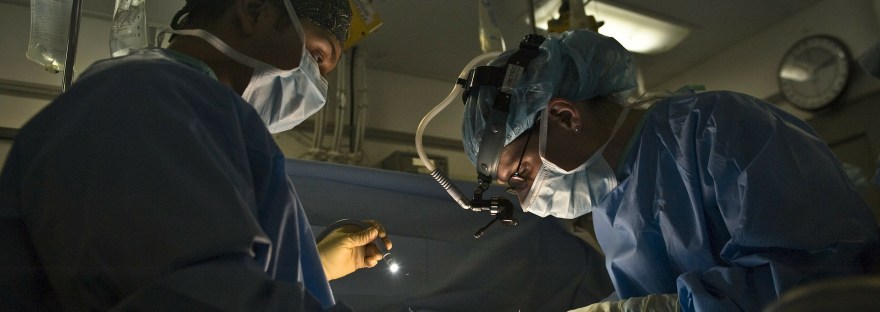
Image: Surgeons in an operating theatre dressed in green scrubs with headlights and masks from Pixabay.com

 literally stories
Another cracking piece of story-telling from Ed.
I particularly enjoyed the melancholy that the MC eventually found.
Let’s hope Ed is content and doesn’t want to edit it!!!
Hugh
LikeLiked by 1 person
I recall Ed’s willingness to edit the original version of this one. He did a great job, and never complained.
Leila
LikeLike
Brave to write a story like this with the knowledge that the guy with the crooked nose was indeed just waiting round the corner. Another well written and entertaining piece. dd
LikeLiked by 2 people
“Purity of heart is the only success worth having.” – Tennessee Williams
Great job, Ed!
Dale Williams Barrigar
LikeLiked by 1 person
A last line of the very best
LikeLiked by 1 person
Yeah. Sometimes, hopefully when it is the time, it’s okay for the guy with the crooked nose to do his job. Otherwise, we would never leave this place and that would be worse. Great story! — Gerry
LikeLiked by 1 person
Well-written and poignant in its own right, but even more so given what we know.
LikeLiked by 1 person
A sparse but effective piece of spookiness! Well constructed and nicely paced.
LikeLiked by 1 person
I wonder if anyone else has the MC’s fantasy life. That’s a lot of near deaths for a 37 year old. For comparison, mine have been in cars and around waterfalls.
LikeLike
Highly entertaining and whilst menacing I also really enjoy the lightness of such a macabre subject – this was fun and unnerving in good and equal measure.
LikeLike