
On this first day of May, I return to the abandoned farm I once owned and stand in a pasture now overgrown with creeping jenny vines and clumps of brilliant yellow buttercups. Slatey gray clouds collide above me and fold into each other in a birdless sky. A whispering breeze ruffles the tops of the leafing red maple trees. Half a century ago, I found an abandoned narrow-gauge rail track set on hand-hewn locust ties at the back of the farm. I was unaware of their presence until months after the purchase and could only guess their purpose. Shuffling several ideas, I thought they might have been used to bring wheeled carts of fieldstone or firewood to the bottom of the hill. Or, perhaps maple sap to boil in large vats for spring syrup. I enquired at the local historical society and asked my neighbors, but no one had an answer, only more guesses.
These tracks were unexpected, and I wished they were not there because they interfered with my plans to make bridle paths for my horses. Starting at the end of the pasture, I drove my tractor into the woods until I met an obstacle I could not move, then I shifted direction and plowed ahead until the next block. As I wound this serpentine trail, my thoughts wound with it. The forest became my library, where I did my best thinking and sometimes composed a story, poem, or song I sang only to myself.
I was strong and healthy, relishing the hard work of cutting trees with a chainsaw, clearing multiflora and bull briar with a brush cutter, and pushing the debris with the tractor into mounds that became refuges for small animals and ground birds.
The trails were familiar, like the back of my hands. Hands formerly cabled with strength and callouses now gnarled with arthritis, weak and painful. I tramped these trails with impunity on sturdy legs, wearing heavy boots. Today, I struggle, aided by a cane, and stumble over roots.
I did this. I made this woodland network in better days. The forest’s solitude and beauty enhanced the work’s enjoyment, with birds singing, squirrels scolding, and the occasional deer that stepped out of the brush and stared briefly before bounding away. I close my eyes and relive the lazy rides clopping to the squeak of saddle leather, the fly-swishing tail, the occasional huff from the horse’s mouth, and the soft sounds of hooves on the turf. I rode on trails where the overstory blocked the sun and moss grew like a lush green carpet. On the east side of the hill, I found the ancient farmer’s last furrow, turned a century ago by a man with muscles, a horse, and a single-blade John Deere plow in a line once arrow-straight, now, forced by time and weather, it undulates horizontally along the slope like a slow-winding snake. Those days are only memories now, an old man’s faded past.
The dead pine ahead stands like a naked black beast with a vast network of needleless dry branches towering into the sky. Around its base, I buried the dogs as they died over the years, but kept their memory alive in mine and tied colored ribbons on the lower branches yearly at Christmas.
The April rains brought mud and conditions that were difficult to traverse. Yet, I doggedly returned to work with chains on the tractor wheels. I thought about removing the rails and selling them for scrap. But that would destroy history. I had no right to do that. There was no reason to disregard the efforts of others as if they were meaningless.
I considered researching history and writing a rail story, but priorities changed, and I never did.
I laugh, and the hollow sound runs through the forest and ruffles the emerging pale green leaves. How could I fake the rail history when unsure of my story? I’ve come here after many years wondering about that. Who will write my story? How will it end?
I must stop; I’m breathing hard, my steps are weaker, and I’ve fallen twice, earning stains on my hands and knees like a fervent pilgrim at Lourdes. That makes me laugh again, although I should be in tears.
I’m close to my goal; the tracks bend to the right and disappear momentarily in the brush. I struggle, wipe my sweaty face with my hat, and count the steps, setting goals—each one shorter than the last. Finally, I stop to hunch over my cane and rest again. I ask myself, “Why am I doing this?” Recently, the answer would have been unclear. Today, it is not. I picture words—stalwart, resolute, determined, and view myself in their context, adding to my purpose as though I’m harvesting a crop and saving it for future use in leaner times.
Beyond the bend, I see my goal. The place where, more than a century ago, men had purposefully built a large stone pile to clear land for planting. The infinitely imperfect granite shapes gathered together like a whispering crowd, talking among themselves but saying nothing of importance. Is there a more noble purpose? I’m going there today to grapple with my life and move forward, a simple man with simple solutions to life’s problems—one step at a time.
I stop again to catch my breath, then struggle to the top of the hill.
The clouds have parted, and the late afternoon sun is drawing shadows from the base of the trees. It’s quiet, cathedral-peaceful. The day will soon end.
I stand at the circumference of this magnificent stone sculpture, facing west as the sun drops below the tree line. I pause briefly to affirm my decision, eager to end it now and with that certainty, I pry a stone from the ground, and, using two hands, swing it onto the pile where it clacks in place with history.
The birds, scattered by the sharp sound, return. The bold ones sit on top of the stone pile, staring at the man trudging back down the hill tapping the rail with his cane.
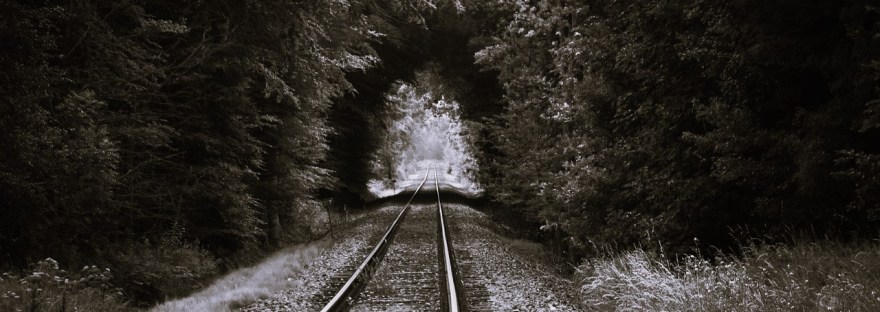
Image by Dirk Vetter from Pixabay – A narrow gauge rail running through the trees.

 literally stories
Good morning Ed
let me be the first to welcome you. This is both poignant and stunningly described!
Leila
LikeLiked by 1 person
Great to see this little piece of memory on the site today. When we are young it’s difficult to imagine a time when thigs will be different and only as time has passed can we reflect on what we once accepted as the norm. I love that the character in this story had such respect for the ones who had gone before and their endeavours. All in all just a charming and enthralling piece. dd
LikeLiked by 2 people
A beautiful piece, wonderfully descriptive and one that resonates with those of us in our ‘advancing years’!
LikeLiked by 3 people
A very fine piece of work, thank you. There’s a lovely rhythm to this. Perhaps not a ‘stalwart, resolute, determined’ narration, but certainly stoical in recapturing the feelings of those who revisit the site of past endeavours, their own and those who came before them.
I used to live in rural Aberdeenshire, where the fields were created two hundred years ago by crofters on ‘improving leases’ – they cleared the fields of granite boulders by manhandling them into ‘consumption dykes,’ boundary walls six-foot deep around the fields. Another enduring legacy.
LikeLiked by 1 person
Ed
Your story took me with it. Either way you look at it, everything returns to nothing. Whether it’s the landscape, that which we build, and always us. “I am Ozymandias, king of kings, look upon my works . . ..” You know the rest.
It makes me glad I never built anything.
Thanks for the ride.
Gerry
LikeLiked by 2 people
Ed
This is an excellent, poetic story of time passing, or slipping away, which, at 57, I’m definitely old enough to relate to, and then some. I was especially drawn to the images of the pilgrim and the cathedral-like peace of nature. In “The Shootist,” his death movie, John Wayne, the dying gunfighter, tells Lauren Bacall, his friend, “The mountains have been my church.” We’re all strangers, or pilgrims, on this earth, and we all have the ability to connect with the deep peace nature brings, if we turn off the shiny happy machines and gadgets and spend some time turning toward the world that made us (nature, in whatever form you prefer, whether it be cats, dogs, wild animals, woods, fields, seashores, or even a single tree in an abandoned urban lot with the weeds sticking up through the cracks in the sidewalk and the wind blowing). This felt like a story of quiet acceptance when up against the pain of aging. The image of the old man alone in the woods with his thoughts really resonates.
Dale
LikeLiked by 1 person
This story had me walking step by step with the narrator. I could feel myself there. Evocative, descriptive and stunning use of words. Well done.
LikeLiked by 1 person
This is a strange ongoing adventure with a character I can easily relate to with the loss of vigor. Old railroad tracks are being abandoned around the world. In England and the USA some are turned into trails. I know how these mysteries can obsess people (me).
LikeLiked by 1 person
A contemplative vibe, so rich in detail. A fine read to end the week.
LikeLiked by 1 person
This has a wonderfully quiet beauty and poignancy. Very nice.
LikeLiked by 1 person
Hi Ed,
It’s an honour to see you on the site.
You really did paint a picture with your words.
A brilliant parallel between the past and what could be done and the present of accepting and remembering.
This is a respectful look at one specific but is relatable to a helluva lot!
Excellent my fine friend.
Hugh
LikeLike
Meditative piece about time and changes…..there’s a theme of being alone though that is never mentioned directly. It’s like the MC is returning home, connecting once again to a world he created just for himself, and the associated memories. The MC is fortunate the new owners haven’t changed the property too much, so he can look back at his history with the place, and all the work by himself and others that came before. Good ending.
LikeLike
Beautifully rendered and the rail track is a perfect metaphor running through this story.
LikeLike