
“What the people believe is true.”
—Nanabush, Son of the West Wind, Grandson of the Moon
I was a story I told myself.
My body required mechanical help with inputs and outputs, causes and effects—the purpose of one function needed to be fitted to the function of a higher purpose, from swerve of nerve to bend of bone, synapse to neuron across the junctions electric.
Body shifts, reflex tests, muscle pulls were performed. Others asked questions neither understood nor answerable.
“Who is president?”
“One plus one is …?”
is your name?”
Yet, a slip stream of reciprocity existed between me and the world. Although I could not touch, sometimes I could feel my face caressed. And while I could not cry out, I noticed the borders between silence and sound, distinguished melodies from riled waves in the air of someone passing by—the way fronds of a fern might bend to a breath of wind.
This lonesome dance of the senses became dreaming and dreaming proxy doing. I dreamed I was e. e. cummings. I dreamed I was a bird on a bough. I dreamed there was a wasteland of islands and rivers, and I went to it over a deep ocean.
It struck me the land was unreal, yet I contented myself with what was there. With me was something like a spirit or the oldest man ever lived, who dreamed with me, which made him as real as anything else. He said he was Nanabush—Son of the West Wind, Grandson of the Moon.
He said my name was Me or my name was George Washington. He bought smoke for us to breathe. When we exhaled, we made Stories. Each breath a memory, each pull a scene, every loop a dream, like on a great river.
He told a story of a Spirit asleep like me in a place not him, who dreamed of ceremonies and drumming and charms, waterfalls and stars on fire.
He said, “Me, it was dark even so. It exists nothing only He, The Great Spirit. Dreamed up the Grand Fathers and Mother Moon.”
His story took a long time. The earth was covered with water, a tortoise raised its back to become land, a tree grew, out of its roots a sprout bore the first man and woman.
When he stopped, he gave me the pipe: “Tell ‘Story of Me’ to find who Me is. Begin where you remember on the Flowing River.”
I remembered nothing. I blew puffs into the gulf to find a thread into my story. When I went to the Flowing River I told “The Story of Me”—as foreign as someone else’s life told in a history book.
My words revealed that at eighteen I was reunited with the love of my life, Ms. Caprice DiMaggio, after a three-year absence for approximately a month of blissful co-existence. Of our time together, I could report few details. I understood there was a lot of necking during those weeks, but this was probably more deduced in mind than remembered from life.
What happened next was as swift a descent into my present unfortunate state as I could have imagined. I came to understand Caprice had a girlfriend, Harriet, who was my friend Raymond Hacket’s sister. There was reason to support, after I was verbally abused and dumped by My Angel Caprice, Harriet co-opted me for her boyfriend like one acquires a hamster from a pet store.
“You’re your own worst enemy, Jimmy Gray,” Harriet said.
It was early fall. It was 1965 and I was Jimmy Gray. Pope Paul VI had just celebrated Mass in Yankee Stadium. U. S. Marines repelled an attack by Viet Cong forces at Da Nang Airport. Precisely three hundred years previously, over a hundred Lenape Human Beings were slaughtered by Dutch soldiers
She relied on clichés and canards to pinpoint my flaws. Sometimes I thought she was talking about herself, she had it down in such analytic detail. She felt she was doing me a favor as my girlfriend to chip away, that I was ore to be smelted into something serviceable, that this was what made her my girlfriend.
“You do everything by the seat of your pants, you know?”
Yes, I knew.
“You’re a disaster waiting to happen.”
She told me why. It was because I didn’t write down things I needed to remember. I treated these boilerplate bromides as backhand validations.
I can’t find my wallet.
“If it had teeth it would bite you!”
If my wallet had teeth, what? Nothing. A wallet with teeth would be as unlikely to bite me as a glass of water with teeth. I took these remarks as hall passes to avoid my real problems, which I preferred to keep to myself. But when she said these things, her face, where her cheeks and eyes met, got compressed and wrinkly like she was squinting into the sun. For some reason, even though it made her look like a talking weasel, and I knew she was trying to be serious, I could spin her around until she became hysterical laughing. Of course, I never did.
“Jimmy Gray, do what you believe, not what others want,” she said as her glasses hopped up her nose.
She wore glasses. Very contemporary with large black frames. Sometimes Harriet’s glasses made me want to be extra nice. It wasn’t a pity thing. Yes, I wanted to make up for the glasses, which, let’s face it, weren’t that attractive. They made me want to see beyond banging my cheek bone into her frames or figuring out where my nose went when I kissed her. On the other hand, her eyes looking out, magnified behind the lenses, had a positive effect because she had really nice eyes. Like a pair of blue gourami swimming around in two little fishbowls.
The sexiest thing was, she’d kiss me with her glasses on, mostly, but if she took them off, if she put them on a picnic blanket or into her pocket— or let them drop—I’d get a lump in my throat I’d have forever
A ghostly Black and White Seagull, flapped-out from a roundtrip to the Caribbean with the family, squatted with its poor hollow wings aching on a streetlamp outside the Sunset Park Pool on Forty-Fourth Street. It was an unnaturally hot Indian Summer Saturday. Harriet Hacket and I banked under the gull on our bikes heading for a midday swim, then down to Shore Road to relax on the heights where we might find a breeze with some autumn in it.
Three hours later, we peddled with rolled towels and wet bathing suits under our seats across Fourth Avenue toward the warehouses and docks along the Brooklyn waterfront.
Breukelen: The Broken Land, Dutch. Lenapehoking: Land of The Common People, Lenape.
Brownstones with stone stairs like miniature, inner-city Aztec temples stood shoulder to shoulder rowhouse style to share laughter, nightmares, and screams of love and anger. On top of the stoops were concrete lion planters with a geranium apiece that smelled like cat pee, depending on the season, with a family in the basement with views of trash cans. Stoep: Stoop, Dutch. Alewihaonink: Porch, Lenape.
I scanned a car window with Me in it as we waited at an intersection. It was Jimmy Gray. We peddled into the canopied darkness of Colonial Road. I wheeled next to her.
I stood on the pedals of my stripped-down English Racer. Harriet rode a big, red Schwinn—hard to move, fat tires, broad handlebars with an oddly small, silver ringer she worked brrrring, brrrring with her thumb. She angled in front of me, eyes over her shoulder, and wiggled her butt. We were confined and connected to each other in the gears, the distances between, the breathing, and the words of “The Story of Me.” Harriet Hackett and Jimmy Gray in space and time down the sloping heights toward a street we could never reach, caught up in The Paradox of Zeno’s Arrow, toward the Flatlands of Brooklyn and Coney Island.
There was more sky.
Konijnen Eiland: Coney Island. Dutch. Menateyunk Sekaxkte Chemamtak: Isle of Rabbits. Lenape.
A suspension of narrative rapport occurred while Harriet and I spun our wheels between Ninety-fifth Street and the retreating universe. Nothing was possible, not even motion, until there was the distinct pong of smoldering herbs—hemp or sage. Nothing could be gleaned nor spoken of my story, nor could I tell it, until Nanabush came into the moment.
“The arrow of ‘Story of Me’ is stuck,” he said. He blew a beam of smoke into the scene. I forgot, or forget, or will forget I was telling my story to Nanabush across the Ever-cycling River. My story was out of tense. Was I telling it in the present about the past? Or in the past explaining to my present self what already happened? Or was I inventing a story to become Me at some future date?
The two figments of my story, Harriet and I, were lost in every relative respect. “Why is that?” Nanabush wished to know. “Why Zeno arrow can’t hit target?”
I told him Zeno’s arrow can never hit its target, because “it has to go halfway, then halfway again, and again … forever.”
We applied the pipe to this problem. We sat with foreheads pressed against each other until Nanabush’s words came out in foggy trails, word-by-word, in this order: “Reason story go halfway, Zeno think too much. Arrow lack courage waiting in air for time to catch up or distance slide back. Either way. Launch words. Okay. Link with Grandmother Moon and Father Sun, finish Story of Me
The Schwinn and the English Racer parted and rejoined many times in the lull of the afternoon. We found a bench in the shade of a sycamore shed of brown bark down to the green under-skin with its leaves rattling at the breeze. The sidewalk was free of mothers pushing strollers, kids, and lost souls, so I put my arm around her to listen to the tree, just in case. I felt like holding her. Maybe she would take her glasses off. Maple seeds twirled in the gaps between the breezes above our heads, each on their course along the chain of life with a one-in-a-million hope at becoming half a sapling. Harriet was sullen, projecting the magic of passive aggression over the iron fence upon the choppy blackness of The Narrows’ waters. It was the emptiest of the faces she had available. She trained a wide un-focus on the clouds. Perhaps it was something I did or said or was.
I plucked a poly-nose from the air to alter the mazy mood, broke it in half, peeled it at the seed head, and licked the sticky milk to adhere to the tip of my nose.
“And besides,” she said, softening in mid-thought from her bad place
“And besides what?”
“Just besides.”
She turned to me, saw my face waiting to hear what she had to say.
“You have a polynose on your nose,” she said like breaking news
“It must have fallen on my face from the sky or a Maple Tree.”
No one stayed angry with a person wearing a poly-nose.
She snorted but smiled her smile and turned her left hand inward to finger my shoulder, like a woman playing a cello, as we looked over the fence into the harbor. And we were happy together among the Maple Trees’ spinning children.
A bunch of guys came our way in studied hostility along the sidewalk. It was getting dark. They cruised with quirky moves in identical black outfits. I knew not to do or say anything. I could tell, the way you can tell, they were from somewhere else. Red Hook or Bensonhurst. One sat down next to Harriet. He didn’t say much either. Three others hung against the iron fence in stern nonchalance
“Nice nose,” the guy said.
My chances for a tactical bluff were none. “How much ya got on ya? I’m taking a survey,” he said, leaning over her. I shrugged. The guy smiled. The poly nose unhinged.
“Nice boy like you on a bench with Ginger here must have a few bucks,” he said. He put his hand on her knee. I hated her fat, chubby knees. How she closed her eyes. How she persisted, latent on the bench, trying not to breathe. How I was in charge of her and her knee
“How about your skanky friend here? What’s she got?”
He squeezed her knee, looping his fingers up the inside of her thigh looking into my eyes. Smiling. I had a left jab my father taught me. He only had a left jab and that’s all I had. There wasn’t anything to think about, so I stood up. What with Harriet, her thigh, and the skank business, I cut a left jab at his face he ducked under. It was more a gesture than a punch. His smile grew tight around the hinges. He blocked another obvious left, then threw round-house combos I slid between. He closed in, grappling, punching my ears and ribs, a mix of boxing and street jujitsu. We began a painful dance. He raised his knee into my nuts several times, which I rode like a hobby horse. We settled into grunting choke holds and standing head locks, his greasy hair in my face, and tripping moves to leverage the other over. I considered the ironies of what we were doing and the sharp stink of his black shirt. We gazed into each other’s eyes as we bounced off parked cars and park benches with our heads and shoulders in each other’s arms. I saw for a split moment what looked like an unfocused Man-in-the-Moon float in front of my face. I launched my previously unavailing right fist into the moon
There was something on his face he hadn’t previously noticed. He stumbled back, probed his nose. Blood came tripping red between his fingers. Slow crimson dots splattered the street like a Jackson Pollack painting on the sidewalk. The others were on me before I could apologize. I hit the concrete. What I lacked as a fighter, I made up for taking a beating. I sang a song to myself to change the tone and interpretation of my situation. I sang a song the family used to sing when we were happy and us kids bounced in the back seat of the car. I used the song trick to distract me getting stitches or wringing out leg cramps.
Beautiful dreamer, wake unto me. Starlight and dewdrops are waiting for thee.
Well into it, one of them decided stomps on my head were appropriate, which compressed my face into the pavement composed of sandstone, clay, gypsum, and little, almost translucent yellow and white river stones. Folding into a warm place under the concrete street, I completed the last phrase.
Sounds of the rude world, heard in the day, Lull’d by the moonlight have all pass’d away.
I thought I heard Moon Face singing and Harriet screaming or all of us were screaming, until nothing was but the moving away into the sidewalk, expanding into the elemental world. A guy stuck a knife into my left lung through my back ribs, like slipping a plug into a socket. Sleepy and sweet. Polynoses spun. Harriet’s glasses came off. It tasted warm and sleepy like my mother’s milk. Nebula sweet.
I was at the end. I tried to find more things to say. Someone moved forward to cup the back of my head.
Nanabush blew smoke rings into the dénouement of The Story of Me
“Go Milky Way?” he asked. “Be star. Or want try person again? Find who you are next. Okay? This one not so good.”
“Christians don’t believe in spirits reincarnating nor becoming stars,” I said.
“Don’t believe in Nanabush neither. Want come back two people? No problem for you.”
“One, thanks. Will I remember Me?”
“You need tell story where river flows in circle with the next you to remember Me. No problem for you.”
“Who was Me, anyway? Was Me Jimmy Gray?”
“If you want. You two seem hit it off. Want come back girl? Take your time. Not too long okay?” “Can I still be a star? In the Milky Way?”
“What the people believe is true,” he said. “You find out soon enough.”
Nanabush drew a celestial hit from his pipe that sent embers to his eyes. He sat, crisscrossed, sparkling in the dark.
My eyes opened to a bank of milky florescent lights. The Story of Me was over.
I said “Hello” to a person who hurried away as Jimmy Gray began to reboot. Soon, others came. A woman asked, “Who is President”
“Georgie Washington.”
“What’s your name?”
“Me! Or Jimmy Gray. Either/or,” I said and people laughed.
Saigon had recently fallen to the People’s Army of Vietnam and Secretariat won The Kentucky Derby. The Common People had been removed from the Lenapeoking to Oklahoma by United States soldiers for many years.
Soon, I was reintroduced to my parents, some friends, and a woman who said she loved me truly, times two, kisses squared. I was reintroduced to my parents several times over the next months. My friends were not that interesting. The woman would need some getting used to, if ever. I stared out the window into the night at The Milky Way.
My memories began then. Both forward and backward in time at Twenty-Eight years old. I headed into the future and into the past, to enlighten the gaps, to bridge the missing years at the dawn of “The Story of Jimmy Gray,” both a tick ahead and a tock behind myself
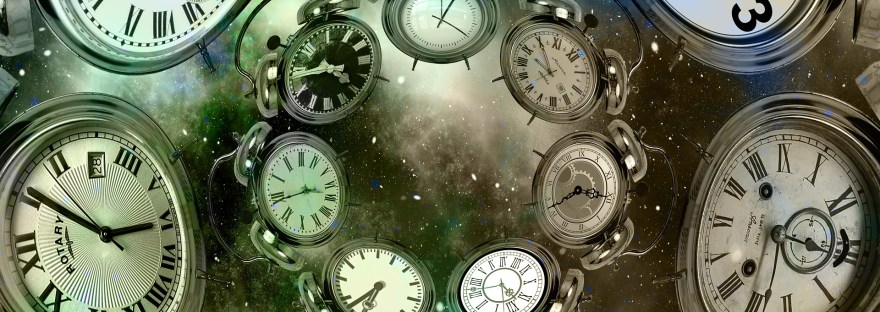
Tik-tock: Passage of time. Dutch. Petawsienk: At this time of our lives. Lenape. And never for the rest of my life did I ever get it right.
Image: A whirl of clocks moving back in time from Pixabay.com

 literally stories
Gerald
I choose to understand this one bit at a time, the same way Jimmy reboots via a series of seemingly unconnected small events. Such a great flow of visions and changes, which gives this substance. It reminds the reader that sometimes a story must be absorbed rather than attacked.
Leila
LikeLike
Thanks, Leila
What I liked, in theory, about writing the story was that Jimmy Gray didn’t know what his story was going to be, nor how it would end, UNTIL he tells it.
To your point about “sometimes a story must be absorbed rather than attacked,” the narrator both tells his story and listens to its unfolding at the same time — both telling [attacking] and absorbing what he says.
It all makes me feel like rewriting it over and over, but I better not.
gerry
LikeLike
A strange journey of a story but a really enjoyable read. Snips and snatches of this and that woven together to make a whole was how it seemed to me – very clever – thank you – Diane
LikeLiked by 1 person
Thank you, Diane!
In telling the “snips and snatches” of Jimmy’s story, I tried to keep in mind what might be naturally in an 18-year-old’s head without going all fairyland. Being inside one’s head was bound to be weird enough. Particularly with a Native American deity in the there with him.
[There had been a Lenne Lenape Indian massacre committed by Dutch soldiers a few miles away.]
gerry
LikeLike
I absolutely loved this! The flow of it, the wordplay, the mix of the fantastical with the historical – wonderful!!
LikeLike
Steven.
Thanks so much. It was fun to write. Well, not really. Writing isn’t fun, except sometimes in retrospect.
gerry
LikeLike
When the author wrote of Nanabush, I was reminded of passages from books by Carlos Castaneda, particularly about fragrant smoke from a pipe. The story was a little difficult to follow — perhaps intentionally so. I wasn’t sure if it was the tale of a young man who was beaten senseless and wound up recovering in a hospital, or the story of reincarnation. The awkward perceptions of a young man were charming and I enjoyed the story.
LikeLike
Dear Babytope,
Thanks!
I just tried to write like an Eighteen-year-old in a comma with whomever might come to visit with him inside his head. There was a Native American massacre of Lenne Lenape Indian families committed by Dutch soldiers a few miles away across The Hudson River.
It all seemed to make sense, but of course, there was the fragrant smoke from the pipe. Can we smoke in a comma? Jimmy and Nanabush had no problems.
gerry
LikeLike
Good story. I like how the narrative voice blends poetic prose and stream of consciousness for a dream-like effect. Open to interpretation… in a good way.
LikeLike
Thanks David,
I did some research on what people in commas remembered of their experience upon returning to consciousness to little avail. Plenty of Memoirs, but not much of substance.
That was fine by me. – Gerry
LikeLike
Hi Gerald,
There is so much going on here in yet it is quite hypnotic.
The images and snapshots are interesting and thought provoking.
The two parts that stand out for me are the idea of The Turtle and the thought that you only remember the past when you are waiting to move on.
This has some depth to it and it is one of those stories that the reader will find something new every-time they have another look!
All the very best.
Hugh
LikeLiked by 1 person
Thanks Hugh,
The idea that Jimmy had to tell the story to find out what the story was made it easy for me to write somehow. I suppose it provided license to go out on limb now and again.
I have a t-shirt with a big drawing of a turtle on it. Above is a single, lower-case word, dog, which always makes me think of god.
I guess it helps to be a little crazy.
All the very best yourself – Gerry
LikeLike
This seems to be a folk story set in New York city, but … .
An arrow will reach its target (or the ground if shot by a bad archer).
A person who moves half way to hit destination, then half of that ad infinitum will never get there, but will get very close. Former mathematician.
LikeLike
Thanks Doug,
Maybe because I am a former English teacher, not a Math guy, I was always fascinated by paradoxes I couldn’t figure out, even if carefully explained.
That’s why I ended the story with Jimmy feeling always “a tick ahead or a tock behind myself.”
I guess getting very close will have to do. – Gerry
LikeLike
As the story opened I thought this was going to be a fantasy piece of some kind, and then as it became more surreal I was drawn in, but then, to be honest, relieved when a more down-to-earth storyline came in. The pace of the action, and the descriptive ability are superb. The beating scene is harrowing and this is testament to its crafting. The ending is perfection in my opinion, because it does a great job of tying in the beginning, making sense of it, and working as an overall cohesive piece. Great work.
LikeLiked by 1 person
Thanks Paul,
I pondered the problem of how surreal versus everyday life to make it. What might an 18-year-old in a comma think about. His old girl friend or the Native American Deity in his head with him?
A tick ahead and/or a tock behind himself.
It was the easiest story I ever wrote for some reason. I guess there were few boundaries to worry me. – Gerry
LikeLike