
Before data can be captured, it must be desired
Steve F. Anderson
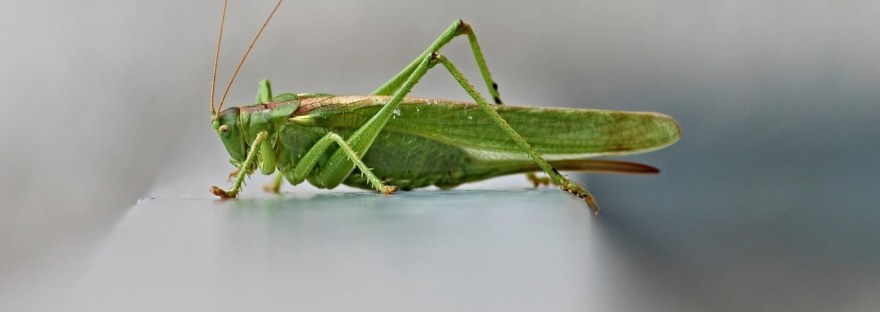
He came out of the tunnel and there she was, perched at one of the patio tables of the Greenleaf Café. Even from that distance her long, jointed legs and oversized sunglasses recalled the grasshopper he’d met that very morning on the bike path.
Dr. Raymond St. Clair, professor of digital media, pedaled slowly through the intersection and considered the insects. Car horns sounded from every direction, but Raymond’s thoughts never swerved. Patterns and connections troubled his mind.
He entered the plaza at shopping cart speed, his bent front rim squealing out a four-count rhythm. This chirping sound caused the woman at the café to look up. She smiled and Raymond saw that she was not a grasshopper after all, but one of his own graduate students, Marina Macpherson. What’s more, she was waving at him from across the courtyard!
Raymond dismounted slowly and removed his helmet before waving back. Even so, it wasn’t until he’d secured his bicycle to a stanchion in front of the shoe store that he realized she was waiting for him – that she was, in fact, the reason he’d come to the shopping plaza.
“I’m so sorry,” he said when he reached Marina’s table, his voice quaking with wonder. He placed his helmet next to her phone and pulled out a chair. “Have you been waiting long?”
“Oh, no worries. It gave me a chance to go over my intro.” Marina was one of Raymond’s most promising students, a Ph.D. candidate whose dissertation set out to reconceptualize the history of digital surveillance. She pushed her sunglasses into her hair and held up a printed draft of an article she planned to submit for publication. “Thanks again for seeing me on a Saturday. This week has been crazy.”
It was a warm day in late September. Raymond squinted at Marina in the hot light. “I do see you, yes,” he said, as though studying her from a great distance. Streaks of lightning crackled at her fingertips and from the corners of her eyes.
“My God, what happened to your helmet?” Marina lifted his head gear from the table. Raymond’s gaze turned now to the fissure that ran along his helmet’s carapace. It was the sort of crack that might result if you tossed a tortoise shell into an open fire and used the pattern to divine the future, as the ancient Chinese once did.
“Ah. There’s a crack in my helmet,” he observed.
“I can see that. Did you crash your bike, or…?”
“I did, yes,” he told her thoughtfully, running his thumb along the crack. The incident returned to him now in a slideshow of muted memories. For a moment his thoughts drifted sideways and he remembered racing in high gear just at the edge of the Dolan Wildlife Corridor. He’d rounded a corner – a blind corner this time of year because of the tall weeds – only to come upon a massive tree branch that must’ve blown down in a recent storm. What happened next was a matter of conjecture.
“Oh no!” Marina’s eyes widened. “You mean just now? On the bike path?”
Raymond didn’t actually remember the accident. In his next clear recollection, he was lying at the base of a gently rattling cottonwood tree, cradled by a field of goldenrod, his head throbbing to the sound of cicadas. That’s when he saw, to his astonishment, a large grasshopper with powerful, striated legs clinging to a leaf just inches away from his face.
“On the bike path, yes,” Raymond said, almost wistfully. “On the bike path.”
Raymond had to smile when he remembered that grasshopper. For the creature’s eyes had regarded him with an intelligence unlike anything he’d ever known, a gaze that conveyed neither judgement nor pity, but only a kind of naked perception – an awareness stripped of all illusions. It wasn’t just the grasshopper, either. Just before losing consciousness, Raymond had become aware that the field itself was watching, patiently registering his arrival among the insects.
“But seriously. Are you okay?” said Marina. “It looks like your elbow’s bleeding.”
Raymond twisted his arm to see a streak of blood pulsating with an infrared energy he was only just beginning to appreciate. “Oh yes, I’m okay.”
“Should you go to the doctor?”
“No, no. It just pulsates like that.” Raymond smiled at Marina to reassure her.
“Jeez. That must’ve been scary,” she said.
“It must’ve been, yes.” Raymond nodded. “So is this your essay?” He reached for the pages on the table in front of Marina. “Can I take a look?”
The habit of teaching now overtook Raymond. Soon he was calmly reading and editing the opening paragraph of Marina’s revised essay. He was already familiar with her argument from earlier drafts. As he read her latest revision, Marina continued to talk about the changes she’d made. But the echo of her words in his ears and the chatter of the words on the page were soon overpowered by another, far more unsettling sound: an eerie pulsation that seemed to originate somewhere behind Raymond’s head. Taking it as a signal of distress, he pivoted in his seat. “Do you hear that?” he said to Marina. “What is that?”
“They have a coffee grinder inside,” Marina told him “It’s super loud.”
He turned to face her again. “Coffee gr – ? No no no. It’s ….” But Raymond broke off his explanation. For all the sounds of the café had begun to work in fugue-like counterpoint with the pulsing distress signal, as though struggling toward a larger pattern of meaning. Slowly his eyes returned to Marina’s paper:
The ocular regimes of the early twentieth-century, whose central and enduring focus was always bodies in space, have given way to power relations expressed through computational systems…
Raymond had to admit that Marina’s understanding of digital surveillance far exceeded his own. Her article wasn’t just a cogent analysis, but the fulmination of a mature and incisive intellect. Marina’s paper would be a significant contribution to the field, that much was certain.
And yet for all her brilliance, for all her youth and physical robustness (Marina was a marathon runner) she remained oblivious to the droning sound in the air all around them. And the signal grew louder every moment. Soon it was so intense, it no longer even qualified as a “sound” so much as a hypersonic pulse of the sort foreign spy agencies were said to deploy against State Department officials to drive them crazy.
Raymond glanced around the open-air café, trying to locate its source. There were about a dozen tables, mostly occupied by students. None of the customers seemed to notice anything. Then again, most of them were looking at their phones. Even those who sat together as “friends” were staring at their tiny screens. The only real visible sign of discomfort came from a young mother who looked up from her device to scold her child as he went about the messy business of consuming a blueberry muffin. “Hold it over your plate, Parker!” she told him – even though, by comparison, the boy was a model of attention and rectitude.
“I guess I’m trying to get beyond the image-data binary,” Marina was saying. “To renegotiate that tension into something more productive.”
“Yes, yes. That’s clear enough.”
The truth is, Marina frightened him. He could see her heart pulsing beneath her tank top like a fetal bird. What was the real nature of her mind? Could she even feel the circulation of her own blood?
As if retreating to safety, Raymond returned in his thoughts to the site of his bicycle accident. When he’d finally regained consciousness there in the weeds, he’d found himself surrounded by bumble bees and cabbage white butterflies, tiny beings that fluttered and hummed over his body like angels. For a long time, he simply lay there and watched, remaining so still a swallowtail butterfly saw fit to land on his bloody knee. Meanwhile, the grasshopper had inched along its leaf to get a better look.
It was during this period of stillness, this moment of coming awake, that Raymond was visited by an insight, a Truth not unrelated to the topic of Marina’s dissertation. He became conscious of a primal kind of surveillance – not a gaze so much as an interpenetrating awareness. The field of weeds was observing him, yes, but it was also drawing him into a relationship, a relationship with significance beyond anything he’d ever attempted to imagine.
“I’m wondering if I should even use the word ‘data’ at all,” Marina was saying. “Or should I follow Drucker and use the term ‘capta’? What do you think?”
“Capta?” Raymond whispered dreamily. “Like something that’s been captured?”
“Right. I mean the term ‘data’ is so problematic. As Gitelman says, there’s no such thing as ‘raw data.’”
Raymond reached out slowly and began to caress the white paper napkin next to Marina’s coffee cup. “There is such a thing as raw energy, though. You’ll admit that? Hertzian waves, for example.”
“Hertzian waves?” Marina frowned and looked at the napkin Raymond was touching. “Are you talking about nineteenth century regimes of vision, or…?”
“Well. It’s more of a pulsation.” He dropped the napkin and turned suddenly in his seat. “What on earth is that sound? Don’t you hear it?”
Marina frowned at Raymond. “No, I… I don’t hear anything.” She regarded her teacher with concern. “Are you okay, Professor St. Clair? You seem – ”
But before Marina could finish speaking, Raymond had shot to his feet so abruptly he knocked against the table with his thighs, spilling what remained of her coffee. The brown liquid spread instantly over the table’s edge, and Marina had to spring from her seat to avoid the spill. “The fuck?” she cried out involuntarily.
But Raymond was already weaving his way through the other tables on the patio, stumbling against chairs and stepping on backpacks until he finally found what he was looking for. The pulsation, he saw now, was coming from a clear plastic bag with a white funnel-shaped opening at one end hanging from the awning near the cash register of the outdoor café. Across the top of the contraption were the words: Bee Safe™ Yellow Jacket Trap. Inside the bag were several dozen candy-striped insects writhing in a frenzy of confusion and despair. As if in a trance, he took the trap in his hands and lifted it from its hook. The bag was radiant with energy.
The young woman at the cash register watched in horror as Raymond tore into the clear plastic with both thumbs. “Sir?” she said. “Can I help you with something?” But Raymond could only let out a sigh of relief as the insects made their escape. The yellow jackets drifted dizzily about his face for a moment before they began to address themselves to the business of retribution.
He felt the first sting on his thumb, followed by one next to his right eye. But the pain only served to quicken Raymond’s new level of clarity. He smiled at the cashier, who had taken several paces back from her work station. “Thank you, no” he told her, wincing as another insect stung his neck. “I’m good.”
Raymond did not return to his seat at the café, and was only distantly aware of the other customers dropping their phones and scrambling to avoid the swarm. He left all that behind him to move slowly across the open courtyard under the hot September sun.
Image by Manfred Richter from Pixabay – Lovely green grasshopper with little red feet and long antennae.

 literally stories
Gregory
The thin line between reality and the Professor’s new temporary (hopefully) reality is beautifully done in this. And having things get increasingly worse at the end is a great idea.
Leila
LikeLiked by 2 people
an intriguing and enthralling piece which sort of gave me the heebie jeebies. Being in ‘another’ reality from your companions would be scary if you knew about it and the fact that you don’t is also disquieting. I think this story tapped into some of my fears. It was well written – Thank you – Diane
LikeLiked by 2 people
A nicely descriptive and clearly written piece that started off quite brightly but then took us to a dark place – great stuff!
LikeLike
Well done. Nicely weird. Had no idea where it was going, but when it got there seemed completely appropriate.
LikeLiked by 2 people
Not so sure about Marina – knows the jargon, but is there anything else? Prof’s accident or something else?
LikeLiked by 1 person
Hi Gregory,
Loved the tone, it was quite hypnotic or surreal or both.
The MC’s new found perception was brilliantly done and we are left with those questions that tantalise.
Brilliant.
Hugh
LikeLike
Bee afraid. Bee very afraid… Seriously this is an imaginative and thought-provoking story. I think the professor’s hallucinations are telling him something real about the threats from things we don’t normally perceive.
LikeLiked by 2 people
Wow, very absorbing and intriguing story. I also liked the clear, simple writing and tone which is ironic and clever because the MC’s thoughts and perceptions are so surreal and abstracted from our reality, for example, when his hearing becomes supersonic. Reminds me a bit of a near death experience and the clarity I’ve heard about from those who’ve gone through it, but in this case it would be a pulsing bees in a bag experience and might be interpreted as a kind of concussion madness. I like the insect theme throughout, a cyclist in a sense does appear to be like a bit of an insect when riding.
LikeLiked by 1 person
Ingenious writing – a modern interpretation of Metamorphosis perhaps? I loved the dreamy quality of Raymond’s post-accident mindset, and then the suspense of the pulsing sound bothering him more and more, and then the superbly handled surreal ending as he gets stung. An odd, but wholly successful story.
LikeLiked by 1 person