

Dock-tailed and white-eyed, the aged collie barked at a boy’s approach. The boy halted and then crept on in silence. Her cloudy gaze remained fixed. Twenty paces down he turned and watched the blind animal still shouting threats at that vacated point. He stood dumb, impressed. Something caught his eye in the rear of Train Man’s house. It was a dark figure swinging a large hammer in the perpetual motion of an oil derrick, and from that ceaseless striking of steel on steel emanated a violence so general it seemed part of the air.
Willard Cote moved into his cinder block bungalow after many years at war in Asia. His taking possession of it came with some controversy. Squatters had long inhabited the land. The Talker always maintained that Train Man, after failing to expel them with his words, arrived one day, leveled an old wooden rifle, and drove them into the barren fields beyond his lot. Another neighbor said Cote simply called in the law. Whatever the means, he took his claim and went to work transforming it.
It was an acre set deep from the road in a long strip, lousy with brambles, the trees all choked with English ivy. A cesspool occupied a corner and garden mounds fouled the uneven soil. Train Man cleared the blackberry bushes and freed the trees from their slow strangulation—two great white oaks and a maple. The stinking pit was filled and the ground leveled. He then fixed up the bungalow, left in all manner disarray; the windows had never known glass, the roof was patched haphazardly with thatchworks of vine and leaf. With singular devotion, all archaic remnants from before Train Man’s time were destroyed. His work took several years. And during this time, Cote avoided all neighbors save Ray Gary.
Ray Gary and Cote had both joined the invasion of Vietnam; this seems to have served the basis of their friendship. According to Ray Gary, Cote’s career spanned Korea, the Philippines, Burma, Laos, Thailand, and Vietnam. When asked who was fought in the years between Korea and Vietnam he replied: “Eastern hordes infected with an eastern virus… the choice was cull the herd or share the spoils.”
In the seventies and eighties, Ray Gary often walked to Cote’s and the two spoke. Mostly Train Man talked about his plans for the property. Many plans in time narrowed to one goal. One evening Cote took Ray Gary into the garage and produced a tattered magazine. In it was an advertisement for a diesel ride-on train set, just large enough for a man to sit in with knees tucked up and hanging over the edges. Puzzled, Ray Gary asked what it meant.
Cote explained himself: “I bought this land sight unseen and when I got here there were people saying it was theirs. After they’d gone and after I’d cleared and patched, I still sat uneasy. In time, I saw this engine and something turned in me. This land—it’s settled now but it yearns on. Here and now and for all times I can reign it in. One thousand feet of American steel will form the rail, one of the oaks’ll supply the ties and there’s plenty of stone in the soil for ballast. A perfect encirclement, no outer bounds, not an inch left unsovereign….”
***
The sun dropped out of sight and the boy hurried home to beat the dark. In the grainy twilight he again approached Train Man’s and before he saw him he heard the hum of the train. He stared as the last car disappeared around the back of the house and a moment later Cote emerged round the other side, full steam in the child’s direction. He sat erect and with his conductor’s cap perfectly leveled held a gaze headlong and terrible as if no physical substance could stop it. The boy paused and looked right back but Cote’s eyes blared white and so he ran. In bed hours later he crawled to the window and raised his eyes to the sill. Through the bushes and brambles and the black night shone a solitary light traveling in a slow rectangular circuit without end, inching wider at every corner.
Samuel T. Hake.
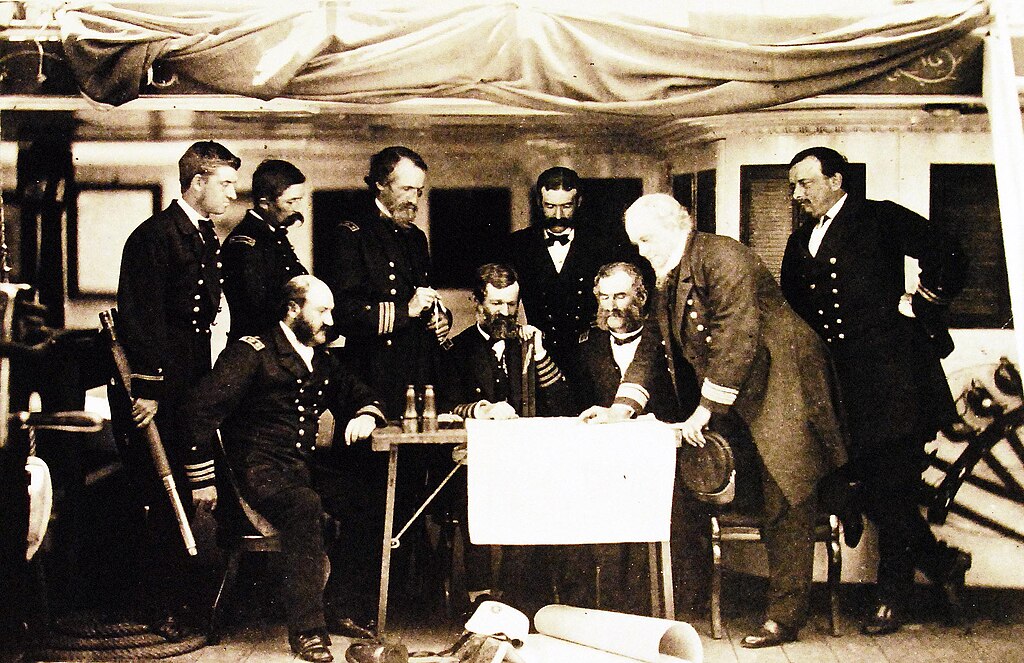
Image: National Museum of the U.S. Navy, Public domain, via Wikimedia Commons.
200-S-KWG-12: Korean Expedition, May-July 1871. Council of War on board USS Colorado before the attack on the Korean forts, June 1871. Standing, left to right: Master John E. Pillsbury, signal officer; Commander Lewis A. Kimberly, commanding the Benicia; Commander Homer C. Blake, commanding the Alaska; Lieutenant Commander William K. Wheeler, flag lieutenant; Rear Admiral John Rodgers (leaning on table); Lieutenant Charles H. Rockwell, commanding the Palos; sitting (left to right): Commander Edward P. McCrea, commanding the Monocacy; Captain George H. Cooper, commanding the Colorado, and Commander Edward T. Nichols, Chief of Staff. Also at NHHC as NH 66308. (6/2/2015).
Banner image: Iby Ronald Josy from Pixabay

 literally stories
This a very rick, evocative piece of writing, steeped in a history I personally know very little about. For me, the thing I loved most about reading this are the poetic descriptions of the land, the house, and even the dog.
LikeLike
sorry, ‘rich’, not ‘rick’!
LikeLike
Samuel
The white eyes of Cote as an engineer is a stunning image. I would run just like the kid.
Leila
LikeLike
A superb piece – wonderfully evocative and unsettling all at once! Very nice indeed.
LikeLike
Excellent drawing of the images and the idea of the light travelling in a slow circle is in some ways sad and and moving and in some ways quite scary. I really enjoyed this read – thank you – Diane
LikeLiked by 1 person
Nice use of imagery and a bit mysterious. The Train Man is a character I’d like to know more about. Nicely done.
LikeLike
Hi Samuel,
An excellent thought provoking story where the historical content enhances and causes curiosity.
All the very best.
Hugh
LikeLike