

The spring sea lapped upon the shore of Yokohama. In the city a familiar New Year tune played over a radio. It had been ten years since I heard that song. I mouthed along the words half-remembered from nights when, in drunken stupor, my friend, the poet Sunokaze Heki, would recite tanka alongside the music.
“I believe it was by Lord Ki, that one poem, how did it go? ‘The first month is turned, let spring come so we may take our pleasure to the limit, as we greet the plum blossoms’! Otomo-san compiled it in 786 you know? Brilliant work, absolutely stunning. My teacher grew up in a monastery near Nara—though of course I forget which one you understand, there are so many—and he read that poem from a collection that was copied from a very well known text in those circles. I should endeavor a copy for you, it is very good.”
“I know nothing of poetry.” I laughed, pushing a distracting cup of sake towards him. During those years I worked as an agent negotiating less than legal trade between certain interests which I shall not name here. What I can say, however, is that my primary product had been the import of sake out of Shimoda. From 1936 until that year of 1941 I traveled between the US from San Francisco to port in Shimoda. My main contact was the aforementioned poet Sunokaze, who had friends further inland that produced much sake in secret after the war in China grew more demanding. Every year he insisted we stop at the inn, and every year I gladly obliged him.
“Do not worry man, true art can inspire even the nescient. I will find you a copy when I go back to Tokyo, kampai!” The two of us downed the liquor.
The Inn where we would meet was set along one of the trails around Mount Amagi . Though small, boasting only five second floor rooms, it prided itself on a few quality things. The first of which being its service. The Innkeeper was a widow whose husband had died in China eight years prior, leaving her to raise their daughter alone. However this experience endowed her with a strong heart, which served her well in shrewdly running the business. As such the food, despite their remote location, was just as good as any ryokan in Shimoda or Ito. Fresh fish from Shimoda came every week, with beef from Mishima every two weeks. The chef was an older woman who most presumed to be the middle aged Innkeepers elderly mother. The second, and primary interest of all who went there during their travels, had been the Innkeeper’s quiet daughter.
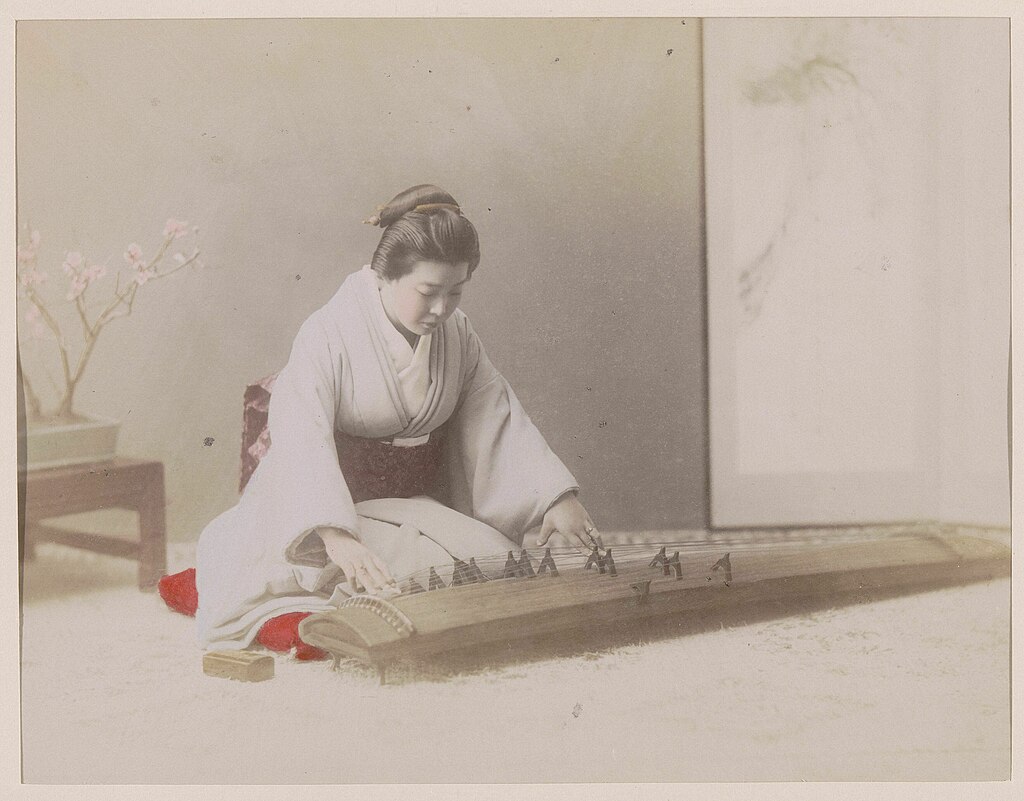
She hid away within her mothers inn on the slopes of Mount Amagi. Plucking away at the koto during meal times. She would lead tea ceremonies in a separate purpose built room on the property as well, though only when high paying guests requested it. Her main passion was her koto, which she would sit by at all times of day, resting her hands on the strings. When supper time came, she would begin plucking them as if it were as simple as emerging from a calm lake. It was always the same song, the only one she really knew. After all, she could not learn new music easily.
“Poor girl is blind.” Sunokaze told me.
“What song is that then?”
“The Sea In Spring, even though it’s winter. I like it very much, I even met the composer you know? Once, in a bar somewhere. Where was it again? Ah, confound it, the man was blind too, like the girl. It was the last thing he composed before he lost his sight, a real poet.” Though definitely a somber song, I could not help smiling as the delicate twigs of her hands tapped away. Her mother, beside her, would play the shakuhachi. According to Sunokaze the mothers part was technically the most active, but the girl’s performance, under those lightless eyes, captivated all who came through the trails of Mount Amagi.
Captivation and insubordination. Several times, during our week-long stays at the inn, vagabonds would shepherd in. Students, monks, really all manner of mobile, listless souls. Yet no matter how holy or innocent any one seemed, occasionally sake would dull their sense. The mother was quick to shoot down any gropers or fiends, but occasionally other men would have to step in. Violence grows easily when watered with liquor.
One night, during my visit in the Spring of 1941, Sunokaze and I had been several bottles deep. It was a busy night as a small trio of students and a pair of fishermen had also been staying there that week. One of the fishermen, an old, burly, fellow, had managed to drink more than myself and my friend. His words slurred and his hands reached. His arrogance was so vindictive that even Sunokaze—normally a pacifist by heart—and I had to step in and pull the larger man away and toss him into his room. We swore at him for attacking the girl, but he was old and stupid, so he fell asleep without so much as a word of regret. When we returned the mistress thanked us dearly and gave us a bottle for free. The girl, sitting in the corner behind her koto, just continued to play. Eyes closed as her omniscient fingers plucked away just as they had for so many nights before.
“Her name is Harumi.” Sunokaze told me later. “She wanted you to know.”
I visited the Inn a final time in December of 1941. It was the usual games between Sunokaze and myself, with the normal party of sake and music. Yet he woke me in the late hours of the night with a fearful expression. War had come between our people, and I would be arrested if I stayed. There was, he said, an attack in Hawaii. We snuck down the hallway, but were caught by the mistress and her blind daughter coming up the stairs. Downstairs a crowd of officers were celebrating their deployment. My friend pleaded with the mistress, so she tucked us into her daughter’s room and locked the door.
We sat quietly, awaiting the leave of the officers. My friend sat nearest the door, leaning his ear upon the floor. As the soldier’s laughter filled my ears I buried my head in my arms. I had never claimed to be a brave man, and what would become of me should I be found was unimaginable.
Harumi, sensing my fear, moved to the koto she kept for practice in her room. Thus she began plucking away as usual, as though the world were not soon to be shocked by devastation and terror. Each string sang gently about the salted waters of Ito beaches. Each somber tone told of the deep and unfeeling comfort of the ocean’s embrace, to which brothers of my own motherland had been sent just hours before. Her fingers were so small, and yet the sound that emanated from them in that moment encompassed my entire soul. The song which I had heard so many times before, just then, sounded like the angels calling. I lifted my head and smiled at the girl as her mother opened the door. The men had gone.
My friend smuggled me away, but I never forgot the song of that blind girl.
After the war I went back to Mount Amagi, but the inn had been burned down. My friend survived in the country, but had no idea what became of Harumi. Her mother, I was told, did not survive. Ten years later I stood on the shore at Yokohama and heard that familiar tune. Laughing and miming along with each pluck of the strings. Remembering Harumi’s final performance for me that night, and recalling her innocent smile.
Image: Rijksmuseum, CC0, via Wikimedia Commons – Japanese woman playing the Koto which is a flat stringed instrument. Banner Image – dream music from Pixabay.com

 literally stories
Thomas
This is definitely the way to approach a time made dusty by history –through the personal touch. You brought back the humanity of the dead and quiet moments soon lost when everything got very harsh and loud. Well done.
Leila
LikeLike
A well written poignant piece that stayed with me for a while after reading it. A nice balance between the terrible times and the emotions without it becoming ‘soppy’.
LikeLiked by 1 person
Beautifully written and deeply poignant. A lovely tale.
LikeLiked by 1 person
The calm of mostly normal events in perilous times. Prior to Pearl Harbor, Japan had already killed so many in China and perhaps other parts of Asia. Not sure on the timeline. The suffering in the USA was much less than Asia.
LikeLiked by 1 person
So well done! I can almost hear the song 💗. I loved this story!
LikeLiked by 2 people
Hi Thomas,
I really did enjoy this.
Very one paced but this suited the story and was brilliantly judged.
There was no great drama just the MC having to hide but it was very well done.
The relationship between the two men was good and the Inn was rather atmospheric and very intriguing.
I wonder if you have read any of Eric Lustbadder. I read the ‘Ninja’ series and ‘Miko’, I think – They are a bit hard going to begin with but once you get into them, they are very interesting. They explain some of the mind-set of the Japanese culture.
Hope you have more for us soon.
All the very best my fine friend.
Hugh
LikeLiked by 1 person
An incredibly moving, poignant, and poetic piece of writing that strongly evokes a particularly time and place.
LikeLiked by 1 person