
“I’ve just told you that.”
When things became worse, I brought my mother to our abandoned-since-Dad-died beach house for the summer. A sabbatical and a newly west coasted daughter freed me to lug Mom like a bag of silent, bewildered groceries into the passenger’s seat of my car. We sped along the highway from the city to the coast, chasing the rickety car of Mom’s memory, lumbering just ahead. I savored the hopeful sensation of control and the encroaching smell of sulfury sea air.
The house, high on a hill overlooking the sea, was left to my father by my grandparents, and was really just a shack, by modern standards. Mcmansions threatened from all sides.
The first night I awoke to find my mother flying on the green sky lawn, face down, her nightgown hitched up the back.
I turned her mud-smeared body on its side, used both my hands to direct her gaze towards mine.
“Home?” she said.
“This is your home.”
“Home?”
“You always loved it here.”
“Home?”
“I’ve just told you,” I said, jaw clenched.
***
“Remember when…?”
“Remember when we sat here at this window, for hours, Mom? Just looking at the sea? How we called it the million dollar view?”
“Remember when we dried the shells on the picnic table? How they were so gritty from sand? All the colors and shapes?”
“Remember when you remembered?”
I was known for being tough, old school. The day a novel was due, I quizzed my students about small details, catching the lazies, fish in a net.
I pushed a steady diet of questions on my mother. Her unfinished sentences, roaming eyes, her hand reaching for a piece of hair, her lack of cooperation, frustrated me, obviously.
My parents’ books overwhelmed the room, lectured from the shelves.
Where was the woman who taught me to read, question a text, argue meaning?
A woman who looked exactly like that woman sat across the table, imposing in her desolation.
***
“I’m going to do some work, then our beach walk, then lunch in that café in town.”
Each day I structured time with purpose, desired outcome, a recipe for both our own happiness, like a lesson plan.
Bewildered by my plans, she’d shrug. Sometimes she’d drop her head on folded arms and sigh. She’d prefer to sit all day, stare blankly out the window at the million dollar view, growing steadily worthless.
***
“So-and-so died.”
Every day I packed a baby bag of sunscreen, melba toast, and spare Depends before enforcing a constitutional on the beach. We trudged along, arm in arm. I made dozens of comments which my mother met with strange noises or silence. She had none of her former interests in shells, fishing boats lolling or cargo boats dominating the horizon.
“Timmy?” she shouted.
“Dad died ten years ago.”
“Dad? Died?”
She halted, shirt flapping, turned toward the sea. The water swallowed our feet, retreated. The sound of her howling rippled out with the waves.
“Carl’s dead too,” I shouted. “Cancer. At Christmas.”
“Carl?” she said, of course not remembering my husband.
The four of us flashed in memory, ensconced in a neat circle of beach chairs, shielded from the winds.
“Mom, I’m really sad,” I said.
“Sorry?” she said.
Finally, I allowed myself to cry, join my mother in her siren song.
***
“Do you recognize me?”
“She knows me. She hasn’t forgotten me. I’ve asked her,” I reassured my doubting daughter.
“Wouldn’t she be better off with professional care? Wouldn’t you? Can you handle this, Mom?”
“She loves it here. I love it. She hasn’t forgotten. Me. She hasn’t forgotten me.”
At night, I’d roam, check the solid lump of her existence, replace her at the window, a blanket draped on my shoulders. I gazed at the rolling slab of black sea, the unchanging reality of that, some comfort.
***
“Do you need some help with that, dear?”
In town, people called her dear, honey. She’d frown, yell, arms flapping. Don’t honey me, honey! she’d have said. She had been an eighth grade English teacher. Who’s she the cat’s mother?
“Look, dear, the seals,” I said, pointing to the window.
My mother obeyed without question, craned her neck.
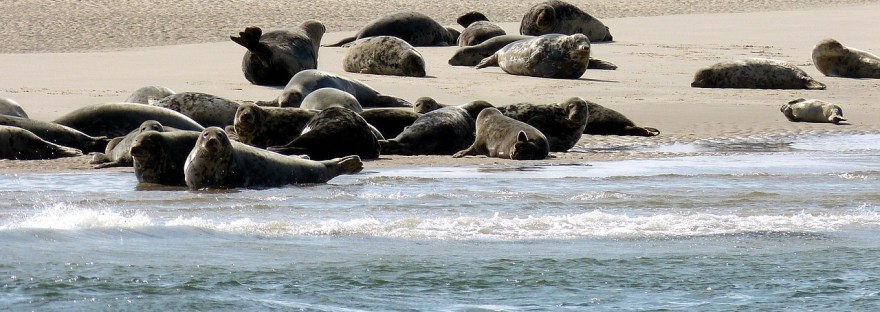
Hundreds of seals hauled out on the beach, molting, shedding their fur. They’d stay there for 12 hours or more for days, maybe weeks. Then they’d head back out to sea.
They were programmed to do this. They knew no other way.
We’d always loved the seals.
***
“You’re wrong. You’re imagining things.”
When her crooked curled finger motioned me closer and she whispered that there were seals in the back of the house, I put my coffee cup down and gripped my thighs.
“You’re imagining. There are no seals in this house.”
“Seals.”
Her face, a clock without hands.
“How could they get in? Why would they want to be in the house?”
“Here. Getting out of here. I gotta-”
I knew enough to remove myself.
***
“It’s for the best. I can’t keep you safe. You need to be safe.”
Out of respect, I told her I was moving her to the home. On cue, she stopped eating, refused her buttered toast and coffee. She cried all day and maybe all night. The moans became intolerable wails. She’d forgotten everything, but remembered about the home.
The seals still rested solemnly on the beach, dozens of dark commas.
On that last morning, I awoke to find the front door open, banging in the breeze. The seals slid into the sea in the night. Her nightgown stretched across the path, her bare footprints in the sand went only so far, then vanished in the foam.
Shameful relief rushed and whipped, then tears, sobs. I returned to the house round-shouldered.
“My mother has disappeared,” I said into the phone.
At last, my words were correct, absolutely true.
Image by falco from Pixabay – sandy beach with seals resting and small waves lapping the shore.

 literally stories
Maggie
This is tremendously accurate and perfectly done. This disease/condition can be a double killer; it often suspends, or even puts an end to the life of the daughter or son who do the right thing. People have to make a special effort to do the right thing; it doesn’t come naturally.
Leila
LikeLiked by 1 person
Happened to my grandmother. At my age all of my previous generation is gone, so I don’t have to deal with it. I hope that my editor doesn’t have to deal with me. At least there will be no premature anything.
LikeLiked by 1 person
Early.
LikeLike
This hit home like a punch but one beautifully crafted and precise in its accuracy. A stunning piece.
LikeLiked by 2 people
Beautiful story.
LikeLike
Incredibly moving and so well handled. “Remember when you remembered?” – is one of the saddest lines I’ve read in a long, long time.
LikeLiked by 1 person
Hi Maggie,
I had one criticisms and then realised that the title addressed it!
I had scribbled down:
Never ask questions, especially ‘Do you remember?’
The title may only refer specifically to the ‘You’re going into a home’ idea but it works throughout the story and that gives this another level.
It is very well done and I, as many of us, can relate to every idea and emotion in this.
Relatable, clever and most importantly, honest!
All the very best.
Hugh
LikeLike