
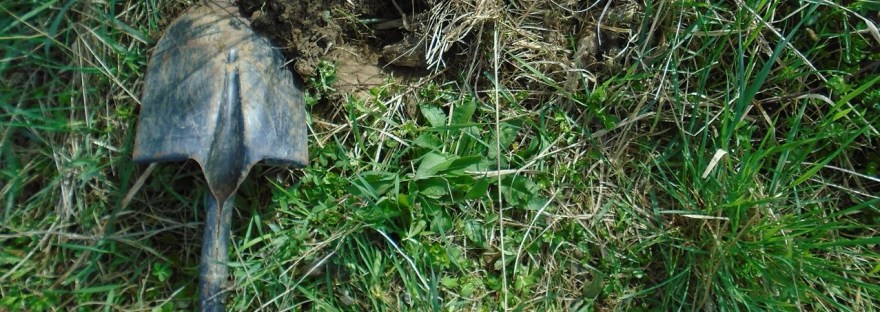
The night had muted the crickets and, as if the fluttering of their filmy, prehistoric wings brought the heat down, the air had cooled into the namesake fog of these Smoky Mountains. The clouds moved into the darkness, rolling down Evelyn’s tongue into her throat, joining the vast, black distances between the flickering bulbs of a far-off holler and the lantern light cocooning her as she worked.
She sliced easily enough through the grassy bald, as she whispered into her shovel dark magic cut loose from that March day when the wild and sinewy farmer’s daughter had been bound by the white dress and given to the musty brown suit. She remembered the wooden church built on tongues, the way the woods around it seemed in a perpetual December even the kudzu vines couldn’t touch. A celebration of appearances and tradition, there had been music and dancing and gifts. Her mother had embroidered the man’s name, Wagner, and the year, 1947, onto pillows. His mother had crocheted the new couple an afghan of puke green. She had smiled that day, despite herself.
The thrill of it would last until the first night she found him communing with the spirits, speaking to them through a glass jar. When the jar was empty, he would see them in her. He would see them in the way she avoided him, the way her eyes seemed to invoke a higher power when she looked at him, the way she would weep when he would start in on her family, her dresses, her cooking.
“You been possessed by some demon or som’um? Wha’s the matter wit you woman?”
But the demons that had taken Evelyn’s body were his own for her to exorcize night after night. And then, each morning, as the early frost became the dew, his lump of flesh, rotting from the day it found his mama’s belly, would rise from wherever it had fallen and, through sour breath, spin tales of dark, evil Evelyn.
This is how Evelyn found out she was a witch, and from then on, she began to cast her spells in earnest, starting with the traveling Reverend Llewelyn D. Perkins, a man as slimy and hairless as the serpents he placed between himself and his god. One evening, the preacher had come by the house to return the toolbox the husband had lent him. He had stood near the door, his dark brown fedora in his hand, until Evelyn invited him to sit at the table and have a cup of coffee.
“And may I inquire as to Mr. Wagner’s whereabouts, ma’am? I’d like to thank him personally for borrowing me his kit here,” cooed the preacher in a genteel drawl strange to these hills. Evelyn suspected it had been put on just like his yellow and green striped jacquard shirt. She’d only spoken to the man a couple of times previously but suspected there wasn’t much holiness keeping him out of the grave.
“You come from Harlan, Kentucky, doncha preacher? Some feller in town tol me that. I don remember who,” Evelyn asked as she placed the kettle on the stove.
“Yes ma’am, Harlan sure is indeed where I spent my childhood. Beautiful country.” The preacher shifted in his seat.
“Mmhmm I reckon it–”
“Though not as beautiful as these here mountains, of course.”
Evelyn sat down at the table opposite the man. “Well no, I reckon–”
“I have very much enjoyed my time here.”
“As I ‘as fixin to say, I ‘as just a wondrin how it is that a boy from coal country Harlan come out sangin like he was that there Looney Toons rooster. You know the one, preacher?”
“Foghorn Leghorn?” The preacher pursed his lips.
“Yeah ‘at’s him. That’s what you sound like, ain it? Course I don mean no disrespect” Evelyn said, delivering the last part with a slight bow of her head. She knew the reference to the bumbling cartoon rooster with the striving, but not-quite-in-the-grammar-books, speech had gotten under his skin.
“And what about the man of the house?” asked the preacher, his accent unaltered. The man was too prideful to accept when he’s been put in his place, Evelyn thought.
“Well I s’pose the ol peckerwood’s out som’erz drankin’ ‘imself into an early grave.”
“Now, Mrs. Wagner, that’s an awful unkind way to speak of your husband.”
“Na’uh now preacher what’s unkind,’ she said, mimicking his lilt on the last word, ‘is the way the bastard come home on Punkin Connor’s ‘shine las night and relieved ‘imself all on my clean warshin.”
The reverend closed his eyes, placing the thumb and index finger of his right hand to the bridge of his nose. “Now the way I see it, ma’am, is that your husband’s affliction, as unfortunate as it is, must be a making of his environment.” He sat up right now. “And I have the view that the best thing for you to do, as his loving wife, would be to ask yourself how you might be contributing to such an environment.”
Evelyn slapped both palms down against the tabletop. “Ah now you know what? I just realized we’re plumb outta coffee in this house!” The preacher’s eyes narrowed. “I ain hardly had a chance to git o’er yonder to the grocery store, what wi all the warshin and what not. You understan, doncha?” As she said this she stood and walked to the door, gathering the preacher’s coat and holding it out in front of her so as to help the man into it.
As soon as he had left, Evelyn got to work, but not on the laundry. For the holy man, she decided, she would conjure his own arrogance against him, and three days later, a Sunday, with the man inside the filling station paying for gas for his ’36 Plymouth, she loosened the hatches on the snakes he kept in the backseat. Later that day, a honeymooning couple found the preacher dead on the road to Maryville of a single bite to the ankle from a testy heat-sick copperhead. Evelyn, on the other hand, found herself more alive than ever.
Next came the grocer, certainly fresher than his sagging collard greens, who told Evelyn, lip quivering, of his wife’s being away in Cosby to care for her dying father. “I do miss her so much. I just can stand bein alone in the house all lonesome like,’ he said, looking downward, shaking his head. “Hit sure would be nice to have some company.” He looked her in the eye now and smiled. His gums were red.
“Ah well now darlin’, I’d be happy to keep you company a little, if ya thank it’d help.” For him, she baked hemlock into a cobbler of his own blackberries and brought it to his door that evening in her Sunday dress.
And so it went on. For the banker it was a long holiday weekend locked in the vault. For the doctor, a scalpel to the throat. All the while, the men of the town lamented the recent lack of security they felt with such a ‘madman’ on the loose. Punkin Connor was moving more moonshine than he had since the depression.
On his last night, the husband began to speak in tongues. Overcome with spirits, he spoke first the tongue of vile hatred. And found Evelyn newly fluent. Delivered wholly by then from the black tar of propriety that had laid thick on her soul, she spat and hissed as he drank and drank and finally passed out at the kitchen table.
“You ugly no-good son bitch! You done tried to steal the best years of my life and here soon I’m a’gon steal yours right back.”
It was as good as an incantation.
In the morning, lip quivering, he spoke the tongue of repentance, asking his dear wife to bury the hatchet. So she did. She walked out the front door and to the shed, returning soon after with the hatchet that she buried into his back as he hovered over the bathroom sink, shaving. That afternoon she thumbed a ride to the edge of the national park where she stole a ’46 Chrysler with Maryland plates from the parking lot of the Gatlinburg Inn, and that night, the smell of rain in the air, she drove into the mountains as high as the roads would take her, the husband in the back, wrapped into that wretched green afghan.
There on the bald, Evelyn laid the last of the dirt onto her husband’s memory as thunder, in the distance, coughed again and again on the thick Appalachian fog, and the oaks and hickories rustled in the incoming storm like so many ghostly bodies come up from the hills to bear witness. She sat against a tree and opened a warm can of Cheerwine cola into which she poured from the husband’s flask. Rain began to pitter patter against the leaves then, finally, through to the forest floor. It dripped into the lantern, and, rather unceremoniously, Evelyn’s world went dark. She continued to sip from her cola, feeling the rain drops on her face, then on her shoulders and legs underneath her clothes. She stared ahead into the dark where the fireflies pulsed and pulsed in unison in their June-time way, and with every round she began to feel that she, too, was alight and expanding into the black.
And, like the black, she was gone by morning.

 literally stories
This is a good, compelling read that really builds up to the catalogue of spells Evelyn enacts with such murderous intent. Very well paced and presented I think. The final paragraph is particularly poetic.
LikeLiked by 1 person
Ashley
Dialect is so difficult to catch, but if this isn’t correct, it ought to be. Dark and funny. Enjoyed her disdain for the preacher.
Leila
LikeLike
Very good writing. Made for compelling reading at 2am. 😜👏👏💙
LikeLiked by 1 person
Reminds of a story set in Appalachia. Sharyn McCrum “If I’d Killed When I Met Him, I’d Be Out Of Jail By Now”. An all female jury might be sympathetic.
LikeLiked by 1 person
Hi Ashley,
I’m no expert (I’m a Scotsman so I have trouble with English!) but I could hear the dialect.
Evelyn is a beautifully dark character and she must have been fun to let run free.
All the very best.
Hugh
LikeLike
What a sort of bleak but optimistic story, a nice combination of bitterness and hope.
LikeLiked by 1 person