
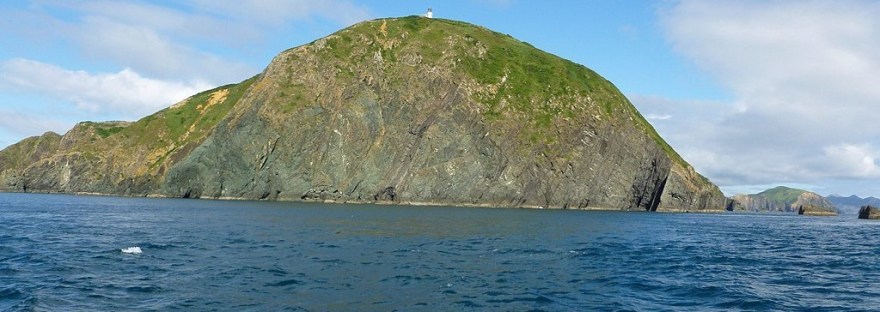
Stephens Island, New Zealand, January 1894
A small brown bird, mouse-like in size and attitude, tucks under clumps of wind grass, scrapes delicate ruts in moist ground. Nearby ocean spray cloaks shore rocks and humpback blows punctuate the sea surface.
A foreign sound. The bird stops, more curious than afraid, peers past grass blades. On a rocky clearing, motion. An upright creature on sturdy legs, with arms capable of lifting and pulling and throwing. More than a dozen of these creatures, different sizes, dispersing into recently erected wooden structures beneath a tall column, cloud-white, capped with a small sun that flares out into the grey mist.
The humans moving into their new dwellings do not see the bird. Soon, however, they will become aware of its existence, they will become excited by the strangeness of it, they will name it, and in a very short time their actions on the island will lead to death of all of these birds.
The humans did not come to do harm. They came to save lives. Deaths were accidental.
#
The bird resumes foraging and does not see a new creature emerge from one of the wooden dwellings. A furry creature, on four legs, low to the ground, graceful, supple. The creature stops, paws forward, head down, stretches down and back, sharp claws kneading the soil. Straightening, it swivels its head to take in new surroundings, whiskers trembling, sensitive to vibrations in the air currents. It spots the mouse-like bird.
Morning, a beautiful day, and the bird’s tail comes up with jaunty confidence and he starts his daily call, clicking first, followed by a sharp, rapid trilling. A unique sound, a songbird singing, announcing his territory, advertising his presence. He stops and bows to pull up a dung worm, opulently thick and long, wiggling and circling, big enough to warrant carrying to the bird’s hungry nestlings. On the dank earth beneath ferns and grasses, the bird walks on short legs, doing what he’s designed to do. He’s a flightless bird.
The cat stalks on silent padded feet.
Sensing something, the bird sees the cat and pauses, assessing the new creature. On this island the bird has few predators – lizards and geckos and a few aggressive seabirds that might occasionally raid a poorly hidden nest. The bird watches as the creature approaches, low to the ground.
The cat has hunted birds before, knows they are difficult prey, vigilant and wary, quick to take flight. This one is different. This bird allows the cat to approach, allows her to get close, before the bird attempts to scurry away. It does not take flight. It does not get far.
For the cat, there is no challenge in this, and yet, still, it is satisfying: the stealthy advance, the contraction of muscles, the powerful lunge. She’s a hunter, doing what she’s designed to do.
Even though slowed by a swollen, distended belly, she finds and kills two more of the flightless birds within her first hour on the island.
She will spend her first days on the island in a gluttony of killing.
#
Stephens Island, New Zealand, February 1894.
Ocean blow whistles the wood siding as the assistant lighthouse keeper opens the door to the small clapboard house, his wife and child asleep behind him. Still dark outside, it is his duty to tend the lighthouse, trim the wick to brighten the flame, lessen obscuring smoke.
At his doorstep, a small bird carcass. A gift from his cat.
He toes the carcass aside and walks the path toward the lighthouse door. He sees a speckled skink wriggling in the green froth of algae along a pond’s edge and a harrier hawk shadow skimming a thatch of creeping ferns. He is an observant man.
A few months earlier, the lighthouse keeper walked with his daughter across Wellington to the harbor, their Sunday afternoon ritual. Her hand in his, they counted the birds they encountered, tracked different species, he felt he was teaching her math and biology. He could name every bird species he came across, at the wharf, in the city parks, the few he saw in the crowded, noisy city streets. He kept logs, tried his hand at sketching them. That afternoon at the harbor, sitting on the edge of pier, their feet dangling above the water, they watched a stream of people disembarking, young men and their families from Britain and Ireland, seeking opportunities despite the absence of jobs, despite shortages in the shops and rising prices for what little was available. He felt his job at the railyard had become tenuous, the railroad losing money and there were always younger, able-bodied men willing to work for less money than he required to keep his family in a small cottage. It wasn’t much, the cottage. Horse-drawn carts thundered past at all hours. Drunken voices at night. A gully ran beside their house, bubbling and reeking of sewage, their tiny yard rendered unusable. Lately, he had heard men at the railyard talking of illness and death working through the crowded houses and streets, the sadness of typhoid fever and cholera, the fear in their voices.
There had been advertisements in the newspapers calling for keepers for a lighthouse on Stephens Island, a lighthouse soon to commence operation, to provide safe passage through Cook Strait where recent shipwrecks had killed hundreds of people. A simple flame there would save many lives. An island wild and clean, unspoiled air, alive with the sound of birdsong, and a noble cause. It was an easy decision.
He tends to his lighthouse duties, but something churns against the edges of his mind. When he returns to his house, he retrieves the bird carcass, brings it inside. At his table, with the window shutter partially open for light, he peers at the specimen. He finds it reminiscent of the small common wrens so abundant throughout New Zealand. Other than a bent neck and obscene puncture marks, it is intact. He presses on the stubby, rounded wings. He cuts opens the bird, notes the flimsy bone structure in the chest, the sparse musculature extending into the wings. He is very excited. He works his fingers inside, pulls skin away, separates muscle and tissue. He cleans out the carcass, props it open to dry in the sun on the windowsill, hoping his wife will not soon awaken. Later, he stuffs the carcass with clumps of sheep wool, stitches the incision, and coats the stiff, dried bird in paraffin wax. He repeats the process with several other carcasses left by the cat. When the wax has hardened, he packages the carcasses and sends them to prominent ornithologists in London and Wellington for their opinions. And for their recognition of the lighthouse keeper’s find.
The cat will take a respite from hunting as she gives birth to a litter of kittens.
The ornithologists will determine that it is indeed a very rare find, a flightless song bird, the first they are aware of. A bird, it is quickly determined, once endemic to New Zealand, now living only on that one small island. Papers will be submitted to major ornithologist clubs; drawings and articles will be published as far away as Europe and the United States. The Stephens Island Wren will achieve some fame among ornithologists’ circles.
The lighthouse keeper will preserve additional specimens and attempt to sell them, with limited success.
The kittens will grow and have kittens of their own.
#
February 1895: Ornithologists visit the island in search of the Stephens Island Wren. They find none. They surmise that feral cats have devastated the population of the flightless birds. The excited clicking and trilling of the mouse-like bird is never heard again.
July 1897: The head lighthouse keeper sends a note to the home office, requesting a shotgun to address the large number of wild cats roaming the island.
November 1898: A new lighthouse keeper hunts the cats with vigor and skill. By August of the following year, he will claim to have killed more than a hundred feral cats. He would say, should anyone ask, that he is taking care of the island, doing what he’s designed to do.
1925: The last of the feral cats is exterminated. The island, lacking flightless wrens and wild cats, is now also bereft of trees removed for lumber and grasses mowed down and hoofed up by grazing livestock, a failed attempt at sustenance farming. Southerly gales routinely scrape the island, salt burn depletes vegetation. Lighthouse keepers note the island’s forlorn appearance.
#
Stephens Island, New Zealand, November 1927
A new lightkeeper arrives. It is not a favorable assignment, the lighthouse no longer as critical to sea safety, the small island not an attraction. There are rumors, also, dark tales of animal slaughter. The lightkeeper had been cautioned about the position, the monotony of the work, the loneliness. It seemed to him a promise. He’d been frail as a child, sensitive, too often sickly. Despite that, he had been conscripted into the army, had found himself in the trenches at Passchendaele, had come home disordered more in mind than in body. He passed ten years in an itinerant haze, failing in a series of unambitious jobs. The human world, he learned, favors the robust. He hopes the island will wrap him in the tranquil comfort of nature and solitude, soothe the ache inside him. He will take advantage of his time on the island. He will become a stronger person, a more accomplished person. He will read a recently procured stack of thick, complicated novels by Russian and French writers. He will take up sketching and writing. This, finally, is doing what he feels he was designed to do.
Upon arrival, he walks the island, sees gray rocks and limp grasses, bushes sloped by incessant wind. He’s seen landscape like this before, outside the Passchendaele trenches, no man’s land, devoid of life and color. Standing near the lighthouse, he remembers the occasional silence that settled over the battlefield, which should have been comforting but was wrenching – waiting for the next attack, the shells, the mustard gas – the silence almost worse than the bombing itself.
His first night on the island he awakens, heart careening, from a dream of artillery shells and gulping mud and the thick, yellow fog of poisonous gas. He thrashes and turns, seeking a position that might induce slumber. Eventually, exhausted, he finds sleep. He dreams of the island, of small clumps of brown feathers and delicate, splintered white bones, of a line of furry creatures, limbs splayed, drying in the sun under a humming shroud of black flies. He dreams of a world robbed of everything.
He awakens, rushes to open the door. He stands in the gray light of early morning and knows he will not last the duration of his assignment. He knows what he hears on this island, he knows he will hear it for the rest of his life, he will tell of this understanding, this moment, to his wife, his children, his grandchildren, so often that listeners will step away from him. Standing in the doorway, he knows what sound courses over foam-sprayed rocks and mossy logs, over shrubs bent by relentless gales, what sound thrums so urgently against his heartbeat, what sound will define this island forever, the sound so much worse than the Passchendaele artillery. The sound that nothing makes.
Herewhy, CC BY-SA 4.0 https://creativecommons.org/licenses/by-sa/4.0, via Wikimedia Commons – Stephens Island , New Zealand – rocky Island with a white lighthouse perched on the top of a green summit

 literally stories
Alain
The reaction to the horrible nothingness created by human action (and inaction) is well captured in this. Excellent all the way through, but especially elegant at the end.
Leila
LikeLiked by 2 people
A fine allegory of humankind’s destructive effect on nature, with a very well-worked ending. I was struck by the irony that even humans are now disappearing from rocks like Stephens Island, as lighthouse keepers are replaced by automatic lights.
LikeLiked by 2 people
This is why we can’t have nice things. Here in Oregon USA there is a big push from politicians to build more houses. More people, more construction disruptions, more and bigger roads, more dystopian society, more pollution and trafic. My father said he wished Blacks would go to Africa, Whites would return to Europe, then he’d negotiate with American natives to be allowed to stay. More is not better.
LikeLiked by 1 person
Hi Alain,
A very thoughtful and thought provoking piece of work that is superbly constructed and beautifully written!
All the very best.
Hugh
LikeLiked by 1 person
Such good writing of a very singular, almost forensic style. In having this distanced, unemotive style it makes the story and passing of time and it’s impact on the environment have so much more emotional impact as a result. A superb example of show and not tell in writing.
LikeLiked by 1 person
Loved how you wove in the story about various battles….both in war and life.
And especially noted the description of the bird: mouse-like in size and attitude…gave me pause. As Paulkimm wrote above, superb example of show and NOT tell in writing. One could almost feel the ‘sound’.
LikeLiked by 1 person
Thank you all for your thoughts, kind words, interesting observations and feedback. I really appreciate you taking the time to read to read the story in the first place and then taking more time to share your thoughts. This provides some nourishment as I get working on my next story.
LikeLiked by 1 person
I like the thought of educating by combining scientific ornithology and maths. Or really, any type of real world curiosity combined with maths or writing. Education need not be so sterile as strictly learning math facts and spelling/grammar seated in a chewing gummed infested fashion desk.
LikeLike