
A man who is middle aged wakes up in a room . . . a middle-aged man wakes in an unfamiliar place where he has lived for the past 30 years, except that’s not right. A man awakens in a house where he has lived since getting married. His wife is deceased, his daughter leaves for college this afternoon (or tomorrow). I’m not sure which . . . but she leaves soon enough and I’ve waited a long time to tell this tale.
The daughter is not well — has been acting strange since her mother departed a few weeks ago. The mother, my wife, died in a car accident or of cancer or a branch fell and struck her on the head as she walked across the park. The girl witnessed the event but insists on leaving for college this afternoon – or in the morning. She’s enrolled at NYU and wants to study astrology, but that doesn’t sound right. Can you major in astrology, even at NYU?
“Astronomy,” she explains. “I want to study the stars because that’s where I’m from.”
The man wakes in a strange room that resembles the room where he has been rising for the last several decades. The details seem different today, perhaps because the girl is leaving in the afternoon.
The door knocks and I . . . there’s a knock at the door: the man leans forward from the bed and asks who’s there.
“Who’s there?”
Like a dream, the girl walks through the room. Judging by the light coming from the window, it is mid-morning: I’ve been asleep . . . the man’s been asleep for a long while.
“Today’s the day,” I say, “you look lovely, dear.”
“Thanks, Dad,” says the woman, “but today is always the day, except when it’s not. That’s what you taught me.”
Near the end of the bed, my daughter holds a purse. Her clothes are black with holes in the fabric; her hair is short and dyed, like a widow looking for revenge, though I’ve done nothing to deserve such punishment.
“I’m going to a movie with Zack,” she explains, “but before I do, I want to tell you something: I want you to know how much I’ve enjoyed our time together, watching you grow into the man you’ve become. And now I must leave or you need to go; or I have to go and you need to leave. I’m not sure which.”
Her face is calm like settled snow, her body as serene as a cipher that’s never been solved.
“Since we were young, Dad, we’ve both contemplated the same thing: Nothing is real except for me. But what you didn’t know, Father, is we were right—in different ways.”
My head and heart are synchronized to the bed. I know what she means. What I perceive as real is as real as perception allows. I observe someone in the room holding a purse: someone is holding a purse. I hear words. After the words stop, silence echoes. I smell the pillow where my wife lay, feel the indent on the mattress where she slept. When I visit the city of Prague (or the Straits of Hormuz), I register sounds and sights. When I close my eyes, the sites vanish. Typing inside a room in a house in Amherst (as I am now), what is real are the fingers on my hand, the keyboard in front of my face and blank words on a crazy screen, or crazy words on a blank screen.
“Your name is still Cassandra?” the man asks.
“It was never Cassandra,” the girl responds. “It’s always been Mel.”
“Melvin?”
“Melody—you call me Mel.”
“Like the diner?”
The narrator is as cautious as the girl: both know where this is headed.
“Like me,” she says, “you’ve always doubted that reality is what it seems. You’ve suspected that forces unseen dictate your beck and call, your whim and wants.”
Our every move . . . .
The girl scratches her nose in a human way before unsnapping the purse. She peers inside as if searching for an answer.
“I want to explain, Dad, before the experiment finalizes and the Big Bang of your you-ness begins anew. You’ve always considered the idea that the center of the universe is not the earth or the sun or some black hole in the middle of the cosmos — but you.”
From beneath the covers I shrug. My back hurts, my bladder aches. I’ll have to get up soon, slip on some slippers and toddle to the bathroom — or wet the bed and worry about the consequences after I’m fully awake.
“In point of fact,” she continues, “you’ve been the subject of an experiment and it’s time to end the charade and implicate someone else in some other part of the galaxy.
My daughter is not well. I can smell the insanity from the other side of the room.
“You know how sometimes,” she continues, “when you’re trying to sleep and you feel like you’re not alone . . . . like there is something outside your vision, watching, measuring your reactions, making notes like an astrologist checking a set of calibrations.”
I nod at a feeling so universal it has slipped into the collective as ghouls and ghosts.
“Such recognition is our way of corroborating what you already know . . . but lack the courage to accept.”
That you’re crazy, the man thinks and repositions himself.
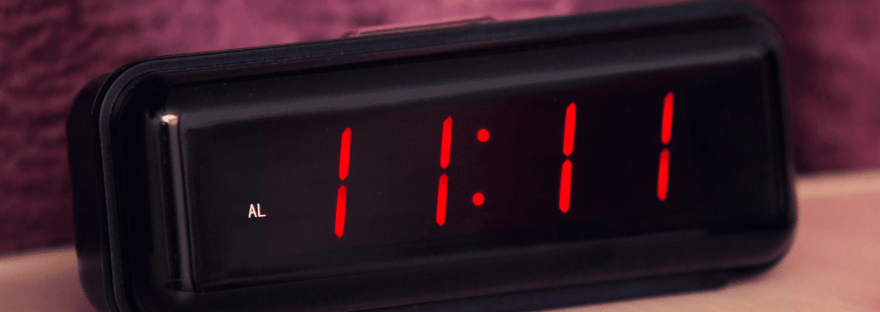
“Another technique we employ to prepare subjects for the big reveal is 11:11.”
The man notices the clock on the dresser: 11:07. Four minutes to spare.
“Four minutes from now,” he says.
“I love you, Dad.”
The woman reaches into the purse and pulls out a pistol. She holds it with the barrel pointed toward the floor.
“Mel?”
“Cassie, Dad. I’ve always been Cassie and you’re a piece of stale cheese cooked too long in someone’s cupboard.”
Her thoughts are teetering between realities; her train of reference is becoming increasingly unbalanced.
“Sometimes people think 11:11 is a moment of synchronicity,” she says. “In truth, it links you and me. . . ”
She waves the gun to indicate the you-ness of herself and the me-ness of the universe.
“ . . . it binds us as a symbol that can be intuited but never understood. Understand? Some think 11:11 signifies the paranormal, or is a sign from angels, or a marker of the soul, but in reality, it’s just us preparing you for the experiment to end . . . in 3 minutes.”
My name is Charles Sutphin. I am the author of this piece in process — the last work of a sad and inglorious career.
“When I pull the trigger, Sut, you will not die: I swear. Your eyes will snap shut to the true nature of the stars and to your rightful place in the cosmos . . . next to mother and me and the other souls wandering across the reaches.”
I don’t remember if the gun is loaded or the safety engaged, or if the man wakes long enough to jump from the bed, tackle the antagonist and find release from a story that needs to end.
We hear the click before the bang, see the smoke before the fire, feel the air before the blow. Everything else is hearsay.
Image: Google images – clock showing eleven eleven

 literally stories
Charles
This one gets the mind moving. It very well may be that the nature of reality is what one says it is. The shifting POV works well here.
Leila
LikeLike
Hi Leila, Thank you! I got lucky with the POV. The shifts may or may not be consistent. I don’t really know (but probably not: lol!) Injecting the authorial perspective into the narrative at the last minute was cute imho. Risky but cute . . . . At the end of the day it’s an amalgamation of voices “consistent” with mental illness? shifting realities? or galactic interference by others? Solipsism run amok? chuckle. . . . who knows. 🙂
LikeLiked by 1 person
Hi Charles,
I love the confusion of the first paragraph which is also so intriguing throughout.
I think that the idea of us separating our-self from who we are and what is happening is something we all do in some form or another. (Mainly to cope)
A very interesting and thought provoking piece of work!
All the very best my find friend.
Hugh
LikeLike
Thank you, Hugh! Truth be told: this story was fun to write. I enjoyed the twisting and the turning. (As all writers know, that’s not always the case.) And then the ending came out of nowhere: Pheewww: got lucky with that! The ending bailed me out. . . . . thanks again
LikeLike
I really enjoyed this – weird and wonderful and disturbing, as all great stories should be! A very nice piece of mid-week surrealism.
LikeLiked by 1 person
Thank you, Steven. I appreciate your encouragement. And you’re right: it does have a surreal flavor to it. Absolutely. Rendering reality [pun intended].
LikeLike
Fun read. Thank you for sharing your work!
LikeLiked by 1 person
Thank you, Rachel. It is a fun read. It was fun to write! and you can’t say that about everything. 🙂
LikeLike
This story has good rhythm and flow, despite the POV shifts and the strange repetitions. That could have been off-putting, but it works here, it contributes to the mood. I liked the straight forward presentation of the bizarre and surreal aspects.
LikeLike
Thanks, Alain. I took a lot of chances with this story: broke a lot of rules, especially in regards to POV. That’s what makes it fun. Too, I love this line: “My daughter is not well. I can smell the insanity from the other side of the room.” –thanks again. . . . .
LikeLiked by 1 person
Wowza. I really enjoyed this. Like, really. I kind of understood it, kind of didn’t…the marker of a brilliant story. Just as I thought that I was getting a handle on things…BAM, curveball, narrative shift. I love thinking about consciousness and the nature of reality. This made me think about them even more. A playful, confident narrative style.
LikeLiked by 1 person
Thank you, Jane. Your comments mean a lot to me at the end “of a sad and inglorious career.” 🙂 I kept shifting reality/perspective on the reader: part Kafka, part solipsism, part Poe in The Tell-Tale Heart. I enjoyed utilizing multiple narrators: I, me and him. –thanks again
LikeLike