
Ms. Almond, our reading teacher, emanated a gaunt pallor and an unfit constitution, and she eschewed the bad breath of old age. She did not seem quite at home in her old woman ways—her shock of gray hair, her stoic and sad eyes, pools of blue that had seen far too much of the world, her permanent wrinkles that spread out like fans from the corners of her eyes and lips. Her etched forehead that told a thousand youthful stories.
There was also that cramped up way Ms. Almond shuffled toward the pencil sharpener; there was the way her shoulders were perpetually slumped and formed a hump between her rounded shoulder blades; there was the way she repeated nearly everything; there was the way she abandoned the rules she set; and, there was the way that she drove her Oldsmobile, her fists perched on top of the steering wheel, knuckles perpetually white, head and neck tilted forward, as her white Olds made its way through Mr. Dix’s circle each morning and found its way into the proper parking spot—right next to the silver flag pole.
Ms. Almond was the first to arrive every morning and the last to leave each night. We all speculated on her sad existence and decided that Ms. Almond came in so early and stayed so late because she just didn’t have anywhere else to go. By the time we reached 4th grade, we came to believe that Room 3-C was the only place where she could escape her lonely, sad and dark thoughts.
We all had our own theories about what Ms. Almond actually did in her class early in the morning and late at night. Of course, we had no real way of being sure until late one night Marty Braverman, my 4th grade classmate, and I sneaked up to her classroom window and peered in.
And, there, Ms. Almond stood alone in the middle of 3-C. And, there we were, too, 1st grade versions of ourselves—maybe from earlier that day, maybe from yesterday.
Then, she called forth an invisible reading circle, and there we all were: much smaller and less pudgier House Henry grabbed the big red fairy tale book that sat silent and fat on the bottom shelf, and with his small hands, he scrambled to sit—if such a thing was possible—toward the head of the circle.
Heidi Smith, cute as a button, held onto her pig-tails so Brenton Sartre, who had moved away inexplicably in the middle of 3rd grade, wouldn’t pull on them. Billy Burger, who now dressed in army fatigues everyday, sat down smack-dab wherever he was and started chewing his fingernails down to the quick.
While Braverman and I peered in through the single-paned window, I realized it was not so much disconcerting seeing our younger selves as it was how we looked to others. I looked tired in my old man’s suit and my clip-on tie. Braverman looked positively country with his cow-lick and his pointy boots. And we acted differently, too: Braverman literally ran to the reading circle like he didn’t want to be caught disappointing Ms. Almond, while I strutted toward the reading circle and remained standing until everyone else had in a more-cautious-and-less-attentive fashion found their way into the reading circle. Braverman put on a happy face and I, a petulant pout.
As if on some silent command, Ms. Almond dragged the wooden stool that usually sat right next to her desk into the center of the circle, too. House Henry leapt up from the floor and placed the big red book on Ms. Almond’s wooden stool and spun it. From outside the window, Braverman and I watched the seat go round and round until the spinning conjured up a much younger edition of Ms. Almond, without the forehead wrinkles, without the etched lines that spread out from the corners of her eyes, without the hump. Fully new, she sat perched atop the stool with the big red book in hands open to the proper page.
Braverman and I pressed our ears toward the window and strained to hear Ms. Almond read of kings with the touch of gold, princesses with long braids locked in castles, and knights who slew dragons for little reason other than they could. Heidi Smith pulled on her hair ruminatively. Billy Burger gnawed his index fingernail to a point and tried to stab Brenton Sartre who made existential noises about his right to exist in a room with no exit.
And, I must admit, with my ear pressed against the cold window, I fell headlong into the stories, too: fantastical adventures and Quixotic measures emanating from good deeds and misdeeds: pretty words and pretty worlds spoken by our now young teacher to our younger less-experienced selves, whose narrative presence seemed to wash over the classroom and then wash us clean.
Braverman was another matter. He was the type of kid who by 4th grade had already lost it all. And, to make up for all that losing, he memorized things. He could recite any number of miscellaneous facts—the temperature atop the Andes, the dimensions of the Acropolis, the inventor of arch supports, the secret recipe for each of 200 brands of Absinthe, the population of Alaska, Alabama, and even Arkansas: Braverman’s father spent a whole paycheck and a half on a set of World Book Encyclopedias, and damn it if Marty wasn’t going to read them from cover to cover, beginning with Book A.
Nowadays when it came to stories, Braverman would throw up his arms in agony. He pressed his ear to the window and whispered to me that he didn’t believe in talking animals or fairies or dragons. He made comments to me about how fairy tales constructed impediments to the marriage of true minds. In Braverman’s world, damsels in distress called to no one, dragons had no one to breathe fire on, and knights’ swords turned rubber and flaccid. And, Braverman like all of us, was in love with Heidi Smith and her pig-tails.
This year, Heidi Smith invited Braverman to her birthday party and like all over-eager lonely boys, he arrived much to the chagrin of her father about 45 minutes before everyone else. Instead of sending him home and according to Braverman, he found his way up the narrow back steps and knocked on Heidi’s bedroom door. He was full of all kinds of fantasies involving the sharing of bubble gum and the touching of tongues and the rubbing of noses. When he found Heidi prone on her bed reading the large slick pages of the World Book Encyclopedia, he said he saw inkblots.
But, on this night ears pressed against the 3-C window, Braverman stood next to me listening to Ms. Almond read and watching his resurrected self. Standing outside, he wiped with his fist tears from his eyes and looked around suddenly and consciously aware of how this must have looked to me.
Then, the story ended.
Then, the stool stopped spinning.
Then, House Henry sat completely still rhapsodically entranced. Then, Heidi Smith stopped fiddling with her hair. Then, Brenton Sartre emerged from the cool cocoon of each story not asleep but leaning against Heidi for support. Then, everything faded from view: the rug we sat on, the spinning stool, the big fairy tale book, and the younger eager and unreceptive versions of ourselves. Everyone disappeared, except for Ms. Almond who appeared standing in the middle of 3-C in front of Braverman and me in the same way that she always had—alone, sad, tired, etched, and wrinkled.
Braverman’s father was an impossibly early riser. He was responsible for watching the switches down at the power plant and on that night Braverman whispered to me that each morning while he had been in 1st grade his father roused him out of bed at 4:00 a.m. so that he could transport him to Peoples Elementary sometime before 6:00 a.m. Braverman told me with earnest wide-eyes that Ms. Almond would always unlock the door from the inside and let him in.
Marty Braverman now tells anyone who will listen. During the next morning’s recess while we stand outside on the ramp underneath the shade of the big light pole that he now understands our willingness to believe in fairy tales manufactured from the thinnest of air. He says that before last night he had always felt like an unwilling participant in a dream. He tells me privately that seeing his image in 3-C let him know a part of him would forever and ever and happily after remain in the safety of that room.
I tell you all of this to suggest that sometimes what it is that we think we see is not what we see at all and that one needs to be careful before jumping to conclusions, even after witnessing events.
I’m here to tell you that some things, even if they are beyond the realm of explanation—at least beyond the present realm—conjure up for us a belief in the possible, and whether or not we can completely surrender ourselves to the unreal depends so much on how we were taught, who taught us, and how much we believe in rereading the past. “It doesn’t really matter much,” Braverman says, “and it matters more than nothing.”
[1] Taken from a novel by Delillo
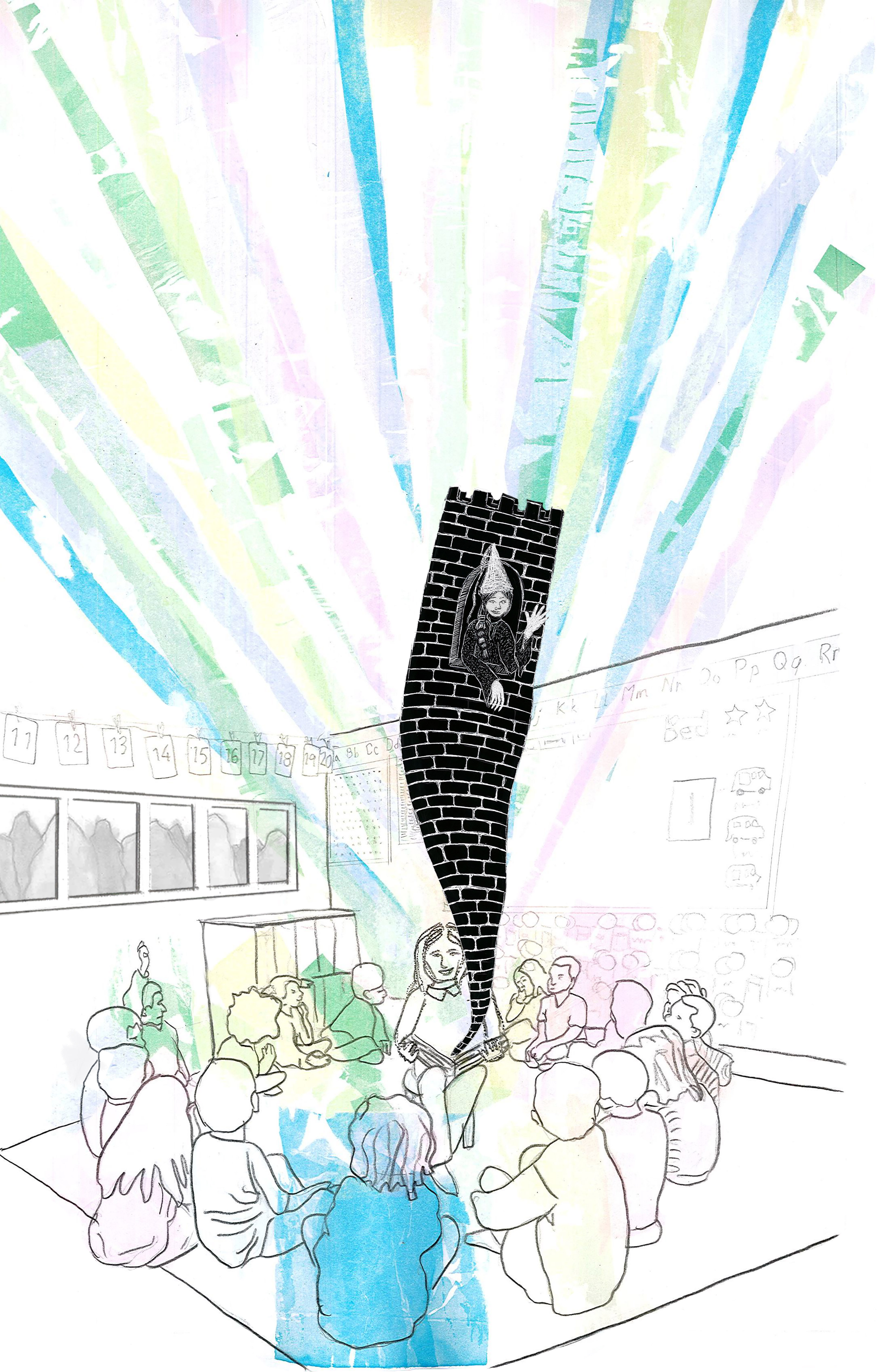
Story image – Lauren K. Sukany, MA | Artist – Beautiful Pencil drawing of a ring of children listening to a story. Teacher in the centre with an open book and a magical castle turret rising up from the pages with a female figure in the window.
Banner Image by Burkard Meyendriesch from Pixabay – old book with red cove

 literally stories
Brad
It’s getting to be a habit seeing you on the site. Another excellent piece. The contrast with the perceptions of childhood and the nature of reality are well laid out.
Leila
LikeLike
Hi Brad,
I’d be interested in the Absinthe recipes!!
Another deep and thoughtful piece of storytelling!
All the very best my fine friend.
Hugh
LikeLike
Another weirdly lovely piece that sends all kinds of thoughts spinning out like a literary centrifuge!
LikeLiked by 1 person
First let me say how much I enjoyed this story time within a story literally framed through the panes of a school window. I hear the siren; I just want to resist crashing against that school building or getting lost in a room of one from my own past only to find there is no exit, my right to exist there notwithstanding. The world Minnick creates here is vaguely disturbing. It makes me feel the way I used to when I watched Charlie Brown and his cohorts ignorantly fumble their way through the world even as they waxed sardonically. All the world weariness of most adults in the minds (and hands) of children. Whenever we find ourselves believing that we “get it,” whether children or adults, we need to check our hubris. Perception is always limited and therefore unreliable. Our perceptions of perceptions are rabbit holes, memories of memories. It’s turtles all the way down….
LikeLike
Such a fun piece. We all should look through the window now and again.
LikeLiked by 1 person
Oh the magic of a teacher! You made it come to life and brought tears to my eyes, as your writing always does. Please keep writing and sharing. It’s wonderful.
LikeLiked by 1 person
A beautiful paean to the pleasures of being read to. In fifth grade, I had my own Mrs. Almond who read to us from Homer’s Odyssey for months after recess. It’s one of the things that made me a writer.
LikeLike
Imagination can be funny, it makes a cloudy day seem sunny.
LikeLike
Another fine piece by J. Bradley Minnick that takes readers to the place. I loved watching the story through the window with the other boys.
LikeLike
This is brilliant. Such a sad, sweet, and loving evocation of the past and who we were then. It always stays inside us no matter what. And sometimes we can even see it.
LikeLike
This piece makes me remember just how important a story can be. We all have one and we all percieve others. Sometimes that perception is fantastical while othertimes its just speculative. Still, often times with a little re-reading and investigating you might find something even more fantastic.
LikeLike
Kind of an Alice In Wonderland feel, anything could happen, and I also recalled the whimsical works of Ray Bradbury. Braverman was funny, he didn’t believe in fantasy but he did have one around Heidi Smith.
LikeLiked by 1 person
The core idea is that understanding the intricacies of everyday life, including education, requires a slow and observant learning process. It’s essential to acknowledge that not everything we see can be fully comprehended or articulated, and commenting without full comprehension can be harmful. The explanation of our understanding depends on our education, reading habits, experiences, and research.
Dr. Brad, as always, connects the past and present with concrete facts, emphasizing the importance of carefully measuring our words when describing what we observe and accepting the mysteries of the unknown. I appreciate your inspirational stories and thank you for sharing them.
LikeLiked by 1 person
A story about story-telling. Very well told.
LikeLiked by 1 person
Love the magic realism with this and felt transported there – a story about stories and in that sense their power of us.
LikeLike
I always enjoy reading your stories, thank you!
LikeLike
This is the kind of sparkling story telling that slowly unscrews the top of your head, with a surreal quality that unwinds the everyday fabric of life and memory; in this imaginative space, the reader is encouraged to rediscover the ways in which the threads of the world shape us, our readings of reality, and the importance of the relationship between the two.
LikeLike
I love this idea that you don’t have to rationalize what you think or know to pull something from it. Essentially, you don’t have to understand to learn. These characters are seeing themselves and reliving the moments, but they are doing it from a wiser and more educated point of view. I like this concept of looking back on your life and seeing from a different perspective and appreciating the moments taken for granted, especially in relation to this teacher they overlooked for so long.
LikeLike
Another attractive piece of storytelling, I read twice.
Thank you for sharing.
LikeLike
A beautiful, mystical, nostalgic story. Reading this also transports me back to the elementary reading circle. Love it!
LikeLike